Aoifinn Devitt: This series is kindly supported by GCM Grosvenor. GCM Grosvenor is a global alternative asset management firm with a longstanding commitment to supporting small, emerging, and diverse investment managers. For over 30 years, the firm has developed expertise in funding and guiding these managers as part of its broader activity across alternative investments. With over $20 billion in AUM dedicated to small and emerging managers and $16 billion in AUM dedicated to diverse managers, GCM Grosvenor leverages its experienced team, broad network, and proprietary sourcing capabilities to support their success. Through the Small, Emerging, and Diverse Manager Program, the firm creates opportunities for investors to access a wide range of talent while seeking to drive strong returns and impact. For more information, visit www.gcmgrovenor.com.
Sarah Fromson: What you could sense was this kind of frenzy. It came across with the pressure on us to take more risk in the managers we selected, the portfolios we constructed. It was visible in the private equity exposure. It was visible in the scale of the buildings. It was obvious in a variety of subtle ways—marketing, branding—and it just made you uneasy. I can’t blame the pressions, that would just be unfair, but it didn’t feel right. And there was a very great lack of diversity. We all know the outcome, we all know what happened, and with hindsight it’s very obvious. At the time it was subtle, but you could feel the pressure cooker.
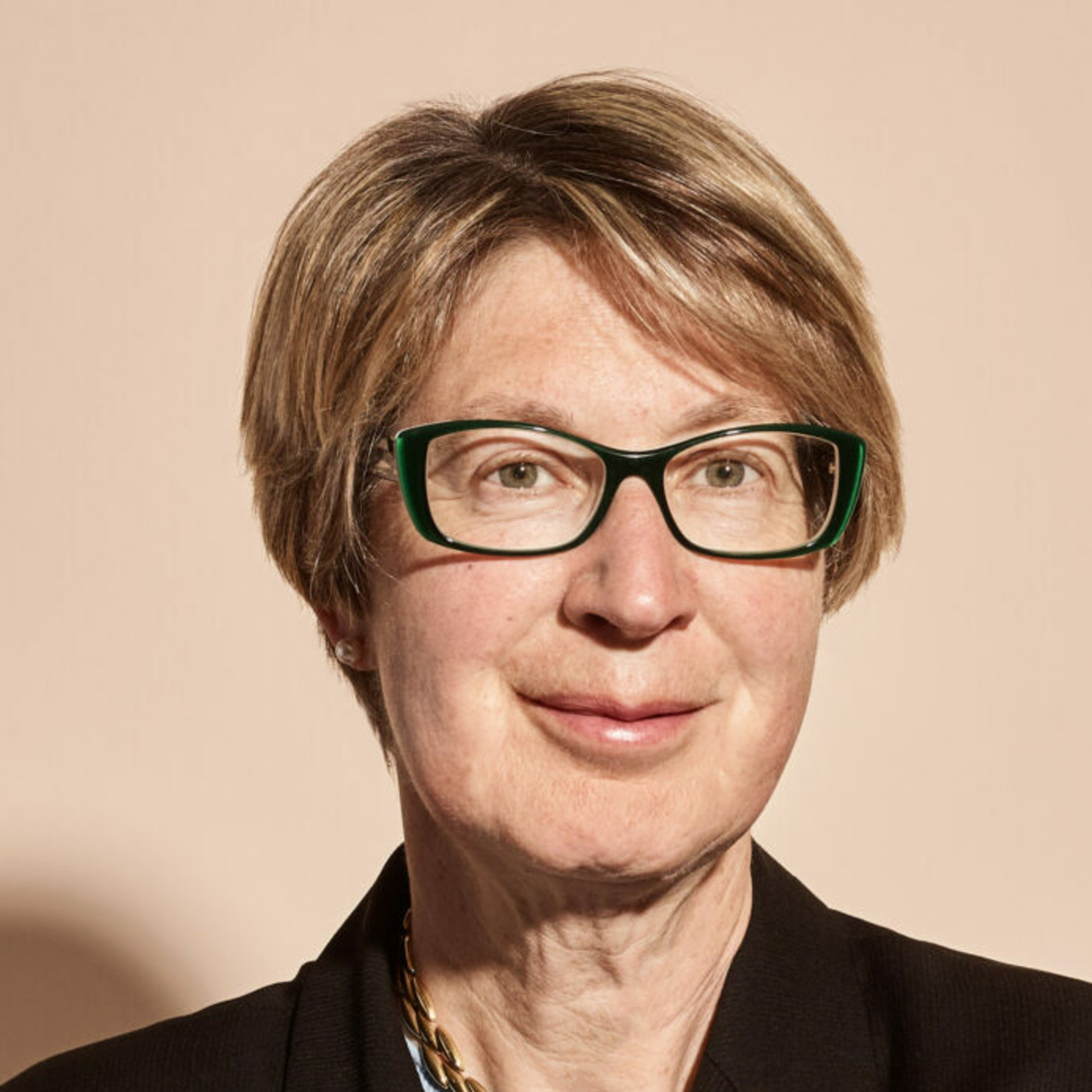
Aoifinn Devitt: I’m Aoifinn Devitt, and welcome to the 50 Faces Podcast, a podcast committed to revealing the richness and diversity of the world of investment by focusing on its people and their stories. I’m joined today by Sarah Fromson, who is Chair of the Cambridge University Endowment Fund Investment Advisory Board. She also holds a number of other non-executive board and committee roles, including at the Calouste Gulbenkian Foundation, Quilter Investors, Capital Generation Partners, and Arrow Street, among others. She spent 11 years as Head of Investment Risk at the Wellcome Trust, and prior to that was the Chief Investment Risk Officer at RBS Asset Management. Welcome, Sarah, thanks for joining me today.
Sarah Fromson: Thank you.
Aoifinn Devitt: Let’s start with your journey into a career in investing and risk in particular. How did that start and did it take any surprising turns along the way?
Sarah Fromson: So it’s a long and winding road to have got here. I started off as a first-generation immigrant growing up in Blackburn and St. Annes in the north of England, and both sides of my family were refugees from Nazi Germany. And my father and grandfather had a scrap metal recycling firm in Blackburn, and it was fascinating to hear their stories over the dinner table. There was a lot to hear. About commerce, a lot to hear about economics, a lot to hear about politics, very little about investments, but it started me thinking about how the world works in an economic and a financial sense. I was definitely not encouraged to join the family business because clearly as a girl that was not going to happen. And I managed to get to Cambridge University, to Girton, which was single-sex then and remained so until my third year. And took a degree in metallurgy. Now, what do you do with a degree in metallurgy? I wanted to work with bright, interesting people, and I wanted a fast-paced environment, and I didn’t want to spend 3 years doing a research project. So I started at the gutter end of the city in commodities. I got an introduction there and started there in 1980, working in commodities in a subsidiary of Beresford, which was the famous sugar trading firm. And I did metals research and I did trading and I did working with clients and quickly worked out that I was good at the research, absolutely hopeless at the trading without a poker face, and okay with the clients. So that was helpful. And then moving swiftly on, stayed in commodities for a while, decided that I needed an MBA at London Business School and moved into pension fund management, and later with Coutts and RBS into manager selection, hedge fund selection, portfolio construction, and then risk management. And I got to the risk management, well, when I really needed it, which was in 2006, 2007. I didn’t know at that stage that RBS was going to go spectacularly bust, but I did feel the testosterone in the air. Fred Goodwin was contagious, and it became clear to me that it was a good time to look for something else. And I was fortunate enough to be taken on at Wellcome Trust to be their head of investment risk. And that was like being on the side of the angels. Because you’re working with an absolutely amazing investment team for a huge endowment that wanted to support medical science and research. And it felt like the best of both worlds and stayed there until the end of my executive career. But it was the risk and the investing that really I loved all the way through. I’ve had less time available and less capacity as a client or development manager, you know, marketing person. But I always wanted to focus on the investing and the risk management.
Aoifinn Devitt: Well, that’s an absolutely fascinating backstory you’ve told us there, and I can’t let a few of those, the nuggets you’ve dropped, go without following up. So first of all, back to those dinner table conversations at the metal business or around the metal business. I’d love to know what attitude to taking risk. You said the family didn’t talk about investing, But they clearly talked about business and politics. And how do you think, in business there are failures, there are investments as part of business that work out or don’t. Did you think you picked up any attitude to taking risk in listening into those conversations?
Sarah Fromson: Certainly, and it was quite an interesting spectrum. My grandfather, who was very Germanic in his approach, believed very firmly in risk management and he was quite a cautious soul. He was the one who insisted on having so much in cash, so much in stock, and so much in receivables and he would vet his clients very carefully. Whereas my dad was the younger and the more risk-taking chap, and he would be looking for fascinating new business avenues. He’d be looking for interesting folk to buy metals off. He was the one who took them into nickel, which was new in those days. It was a new recycled metal, and he was the one who took them into overseas activities. Which I must tell you didn’t always work out. So I learned something from the blend of their two approaches and from the heated arguments that often took place over the dinner table, learning along the way that it’s good to disagree, but if you share a common purpose and you know where you’re aiming for, then those disagreements can be for the common good.
Aoifinn Devitt: Fascinating. And then metals are such a curious topic of focus at undergraduate level and probably not many were choosing that route. And what was it about metals in particular that fascinated you? Was it the scientific aspect of it, some of the physics behind it?
Sarah Fromson: So I did natural sciences, and as you probably know, that means you have a broad base of subjects in your first year and you progressively specialise. And it was serendipity. The metallurgy and materials science department was a modestly sized department with lots of care for each third-year student, really great lecturers, They didn’t have quite the arrogance of the chemistry department, which had a slew of Nobel Prize winners to their credit, as did physics. And I ended up with a crew of great peers in my third year in metallurgy and just loved it. I hadn’t gone into Cambridge thinking I would end up doing metallurgy. I really hadn’t. But it was a good opportunity and a good way of learning.
Aoifinn Devitt: And then just finally, a career in risk management, and we’ll talk a little bit about what investment risk means today, but the words you used about RBS pre-blowup, did a lot of work there, the testosterone in the air. What does it feel like when something is approaching that level of high risk, I suppose? How did you sense that having been in many different organizations? How did you sense that things were just getting a little too much?
Sarah Fromson: Well, I was in the asset management arm and we were managing money for external clients, high net worth, medium net worth clients. But, and I wasn’t sufficiently senior to be best buds with Fred Goodwin. But what you could sense was this kind of frenzy. It came across with the pressure on us to take more risk in the managers we selected, the portfolios we constructed. It was visible in the private equity exposure that RBS had. It was visible in the scale of the buildings that Fred Goodwin was sponsoring, particularly outside Edinburgh, the Gogoburn Building. It was obvious in a variety of subtle ways, marketing, branding, and it just made you uneasy. I can’t blame the pressions, that would just be unfair, but it didn’t feel right. And there was a very great lack of diversity in Ken Goodwin and his best cronies. We all know the outcome, we all know what happened. And with hindsight, it’s very obvious. At the time, it was subtle, but you could feel the pressure cooker.
Aoifinn Devitt: Really interesting because, of course, diversity probably would have meant challenge and perhaps checking of biases, etc. And then that goes to my next question around the evolution of investment risk throughout your career, because I think you’ve hit on something really crucial. I would expect your answer will be around the increasing data we have, the machinery, how we measure and manage risk has clearly changed a lot over the course of your career. But yet you’ve spoken to sort of an instinctual reaction to a growing appetite, which is not something that can be easily measured. There is an art and a science clearly to this. So maybe can you talk a little bit about the field of investment risk, given this is where your last executive role was focused on that, how it evolved in importance throughout the course of your career?
Sarah Fromson: So in between managing pension funds and being at Coutts RBS, I had a shorter-term job in investment risk consulting, and that was in between babies 2 and 3, but we’ll talk about that later. And that was with Quantec. And what was fascinating was to see the evolution of the use of data and the manipulation of data right at the early stages. Computers were gaining in power at that point, and the idea that you could use the risk models that had previously been theoretical constructs and actually use them sensibly within portfolio construction, these were new ideas to most portfolio managers who basically at that stage flew largely by the seat of their pants. The advent of the quants was really the end of the ’90s, the 2000s. Early in the late ’80s, early ’90s, this was still relatively new. And when I moved to RBS Asset Management, We developed a proprietary risk model at that point, which took lots of data, absolutely right, lots of return type data, lots of portfolio construction data, and sought to use it to build portfolios at two levels, one level at the asset allocation and one at the stock selection or security selection level. But I’ve always been very conscious that risk depends on humans, and risk depends on the degree to which individual human beings can take in a risk model and have the intellectual acuity and the humbleness to use it effectively, not to disdain it, not to use it as a Bible, but to say, this is a tool for me. And as we’ve moved on, at Wellcome, the team there was particularly thoughtful in terms of risk management, with a very thoughtful way as to how much they were willing to use risk models and how much they relied also on an assessment of the other types of risk—operational risk, liquidity risk, control risk. Sentiment risk, not all of which, very few of which can be quantified in the same way as sort of traditional investment models, but are nonetheless vital to avoiding the impact of a major blowup. So I’ve never forgotten the mantra that we had at Wellcome, which is for any manager, for any situation, think of the return and the risk that you expect and can deal with but also think about liquidity and think about control. And with control comes the agency issues, the economic issues of who gets paid when, what happens, and to what degree you can influence those. So I think there’s the two aspects of risk management. There’s the quantitative aspect, and there’s the qualitative aspect, which rely on an understanding of calibrating the other dimensions. And that’s not easy. I enjoyed very much the development of my investment risk role at Wellcome because I was lucky enough, for those geeky to understand this parlance, to be both first line of defense in risk terms, in other words, helping management, but also second line of defense in risk terms, which is the oversight role. And there’s not many places you can straddle both. You can’t do it under FCA regulations, but you can do it when you’re managing your own money as for an endowment or for a trust. And that’s a fascinating and a challenging place to be because you’re a poacher turned gamekeeper and you’re helping both sides of the equation. Very interesting and very challenging.
Aoifinn Devitt: It’s so interesting, as you were speaking, the old adage— and I’m going to get it wrong— about the drunk and the lamppost and using a lamppost for light but not a crutch seems how you would recommend using the risk as system, you prefer light but not necessarily aimlessly leaning on it blindly. And equally, my impression of what’s sometimes missing in risk reports is there’s a lot of data, but it’s sometimes an interpretation of that data and sometimes a sense of that qualitative overlay. So I think what you’ve really mentioned beautifully how those two are fused together, and we’ll probably return to risk a little when we go to your now portfolio career. Because clearly that backdrop will be very useful to your current roles. So maybe we could just shift to that now in terms of your portfolio career. I’ve listed a wide range of investment committee roles and NED roles. So why this career pivot? Was it a natural one?
Sarah Fromson: Well, I was coming up to the age of 60 and I felt I’d given some great years to Wellcome, had a wonderful time, contributed and felt I’d, you know, given my best there for that period of time and felt it was time to move into a different set of roles. And so since leaving Wellcome in September 2019, I’ve got a variety of NED and investment committee roles. And the non-executive directorship roles are on the boards of various companies and so on. And that’s where you have to learn that you’re not an executive anymore. That’s when you have to learn that it’s nose in, but fingers out. You want to know what’s going on, you want to be involved, you want to have the final say when it comes to some of the key players, the chief executives and so on, but it’s fingers out, no needless meddling, no getting involved in topics that are properly the province of the executive team. The investment committee roles are fascinating because they split into two types of committees. Some where the committee actually makes the decision. So, for example, at Capital Generation Partners, we’re actually making the decisions at that meeting about which managers and strategies to employ. And some investment committee meetings where the role is oversight and constructive challenge and support to the CIO and the team. And that would be the case at the Cambridge University Endowment Fund, their advisory board, and that would be the case for the Gulbenkian Investment Committee. And again, it’s a complex mix of being fascinated and involved in the investment aspect, but also the soft skills and managing the people and being involved and supporting the people thoughtfully and challenging them come very much to the fore. And I wanted to make that move into that category of roles. And I must say, I started a little bit before I left Wellcome, and I very much enjoyed the last 5 years. It’s been amazingly exciting. I’ve learned a lot, I’ve given a lot, and I’ve had a lot of enjoyment out of it as well.
Aoifinn Devitt: My next question, which I think you’ve already answered, is what makes a good director or chair? Certainly on the director side, this knows In, fingers out, I think is something I’ve heard before. Yes. And knowing how to draw the line, I’ve heard that. And clearly preparation and the usual things you’d expect. And given you’ve seen many committees, the chair role, how have you seen that at its most effective?
Sarah Fromson: So the role of all of these boards and committees often can be summarized with foresight, insight, and oversight. We try and exercise all three. And as the chair or as a director or committee member, what you bring to the table is a combination of expertise and experience and skills, but you also bring the soft skills, the ability to respectfully but deeply challenge, the skill to question, to support, to occasionally cheer up. To coach, to mentor, and to work with your colleagues to provide a coherent team that gives the best outcome for that committee or that board or that enterprise. It’s quite holistic. I think the soft skills are very important. As, as I see it more, you realize even more so how important they are.
Aoifinn Devitt: So on governance, size, board, challenge, you’ve seen a lot of boards. You spoke about the role of a chair, and what is best practice in terms of what you’ve seen, whether it comes to size, kind of building that trust and cohesiveness in a board? Anything that you’ve noticed works particularly well?
Sarah Fromson: The size varies, and it varies according to what you need. I think if you have a shared purpose and you know where you’re aiming to get to, then in your mind as a chair, you need to conduct a skills and— if not gaps, a skills and experience audit and think, what do I need to give the best outcome for this enterprise or this committee or this board? And it’ll come quite quickly. And then you also need a little bit of resilience in case one person’s ill or not doing their best that day. So in terms of size, anything from 3 to 6 or 7 people. More than that, and it starts to disintegrate because people step on each other’s toes. People feel that they can leave it to others to contribute, and you get a lot of— freeloading is the wrong word, but folk who perhaps haven’t had the time to read the papers and develop questions and be thoughtful. You’ve got to be careful about size and to get the complement of skills. And then you want to think about how those people are humanly going to work together. That’s almost like playing an orchestra. Will they humanly work together? Will they enjoy it? Will they stand in each other’s shadow? How do you balance that off? That’s an important part as well.
Aoifinn Devitt: And when you said size, I automatically think of the size of board packs that arrive at times with you the, know, 300, 400 pages. Do you find that needs to be managed carefully?
Sarah Fromson: I do. I think if you’re getting to the 300, 400 pages, something needs to give. People need to provide summaries. People need to be more thoughtful of the papers. I mean, I work with the co-secs and the chief executives that I’m involved with to try and slim papers down. There is a view that if you add in all the last details, then the non-execs are ultimately responsible. You can blame them that they didn’t read page 392 carefully. Now, I do read board packs carefully. Properly, but there’s no way I can take every single thing in. So it’s a constant struggle to say, what do you really need to tell me? What do I need to know? And what haven’t you told me? And those are the 3 questions.
Aoifinn Devitt: Absolutely. Yeah, I know that one issue that I’m seeing more and more is more self-efficacy reviews by boards. There’s a bit more introspection to check that they are in fact doing what they should be doing and that their governance is where it should be. And besides that, what do you find is top of mind for some of the investment committees you sit on today? Just for example, are you spending more time on sustainable investing, on DEI, on focusing on return? Where do you find the focus has been?
Sarah Fromson: So for endowments, it’s perennially on what I call the golden triangle, which is what return do we want to have? What risk are we prepared to take to get it? And at what rate do we want to spend? And that has to be reviewed, and it has to be reviewed regularly and thoughtfully, given evolving expectations of what you can get from different asset classes, or what you might expect to get, and in terms of what you think the downside might be at any point. Because if you can’t bear that risk, then you can’t be taking that asset allocation, and then you have to shade back what you might get for returns over a longer-term period, and then you have to think again about how you might spend. So it’s that constant iteration of how to deal with those 3 issues. And once you’ve got some kind of agreement and understanding amongst all the stakeholders of what that could involve and what it could involve in a nasty year as well as in a long-term reasonable run, then you can start to think about the sustainable investing which feeds in, because the alternative assets are woven into what your asset allocation might be. The ESG responsible investment, I think, has to be part of everything that we do now. We want to leave a world that’s fit for our children, and now I’m also conscious of grandchildren, for our grandchildren to live in, and we have to think about how we manage our assets, how we can be a force for good in terms of the environment, or at least reduced harm. And we have to think about social implications of where we’re investing. Now, the different investment committees and boards I work with are at different stages on this, and often that’s a response to their clients if they are not managing their own money. If they’re managing their own money, then it’s the trustees of the endowment that have to be super clear on where we stand and share that view iterated with the investment committee. And that’s sometimes a difficult path because you have to think about what might you be giving up in the short term if you don’t invest in certain stocks or areas who have refused to improve. You might say that we only invest in companies that are doing the right thing environmentally, or you might say let’s invest in ones that might not be doing the right thing now, but that our managers or we can influence to do better. And I think that’s a more defensible thumb. But whatever it is, we somehow have to get to the stage where we’re not facing 2.5-degree increases in heat. Over the coming decade or so.
Aoifinn Devitt: And I do think regardless of which approach you take, you mentioned you investing with those that are polluting today but are on a path, communicating that is key because that I think, you know, the why often gets lost in the translation because we have snapshots and soundbites and the why might help with stakeholders who would disagree with that position. And I also love what you said about the scenario analysis that you seem to bring in, in terms of ensuring that a strategy is future-proof because you’re kind of almost automatically being the risk manager in you is going through the scenarios that could go wrong, which I think is the important role of a board because often a team, an investment team doesn’t have the capacity necessarily to do that kind of thought experiment, that the day job takes a lot of time. So I think that’s a wonderful example of the use of a board. Building on some of the themes of ESG, if we use that term just in terms of the S part and diversity and inclusion, So your career spanning the investment industry came from a particularly perhaps male-dominated one, commodities and trading, I’m sure had, was well represented or not well represented by women, very well represented by men. Can you talk a little bit about your own journey to a leadership role as a woman in the investment industry? How was that and what did you find as particularly helpful for you to advance your career?
Sarah Fromson: So that was interesting. I joined the city in 1980. And basically it was the era of the dinosaurs. I worked with the first woman on the London Metal Exchange. It was only 5 years past the 1975 watershed when women were able to open bank accounts in their own name. Can you imagine that? Younger women today can’t even think of that, and I’m glad they can’t. I joined a commodity trading firm at a time when the trading floor still had strippograms coming for birthdays. Which was just something else. There was a small number of senior women, but they often didn’t have the time or the energy or the predisposition to help younger colleagues. But I did get support from senior colleagues who were men, and we may talk about it later, but I’ve had excellent mentors and excellent senior folk who I’ve worked for who, who helped me. And I think the key challenge was being able to balance different parts of my life. I’ve always been outspoken, I’ve always been blunt, a northern lass, although the accent’s kind of rubbed off over the last 40-odd years. And so I never— I didn’t find it problematic being the only woman in a room, but I did find it difficult when the odds were so heavily stacked against you, and you just at that point You couldn’t ask easily for help. You just worked harder and did it better and stayed that bit longer. That was a very good strategy. Thank goodness now in most areas that isn’t needed in quite the same way. But now it’s more the difficulties of becoming really senior where the glass ceiling is less apparent in many firms, but it’s still there in some. What have I done to help? I’ve tried to help women wherever I can. I’ve tried to— I’ve mentored a number of women on a formal basis and supported on an informal basis, and also aimed to ensure that hiring shortlists included women and made sure that when we looked for people to do projects, an extra sort of plum opportunities, made sure that women were included in those opportunities. And I felt that that’s, that’s really key because it’s the informal routes for career development that women have really needed and still continue to need. And perhaps now the focus is also on the BAME exposure where the city’s been very traditionally white except for a few small areas.. And I think the onus is, is on all of us to ensure that we include less well-represented groups. We’ll benefit. We’ll benefit from the thought diversity. We’ll benefit from the different approaches. We’ll benefit from just a wider pool of raw talent. But I must say, I’ve never forgotten the strippogram in 1981.
Aoifinn Devitt: Well, that’s exactly why we share these stories. Just a little reminder of how far we’ve come. Even if for many of us it’s still not far enough, but at least some, some things are well left in history. And of course, part of the reason for sharing these stories is because I believe that when we share our stories of setbacks, resilience, overcoming those setbacks, that we, we add to the body of knowledge that can build resilience in future generations. So I’d love if you could share over the course of your career in risk. I know one does encounter ups and downs and volatility. Anything whether it be setbacks or challenges or mistakes that you learned lessons from over the course of your career?
Sarah Fromson: Well, there’s two sides to that. One is the personal and one is the professional. On the personal side, the challenge was always balancing my career with motherhood of three children and changing jobs after each child because maternity pay and leave weren’t then what they are now. It helped me to learn resilience. And it helped me to learn there’s always a way forward and the importance of staying in contact with peers and with industry groups who helped me find the next opportunity and to get back into work. And that juggling continued for many years. And boy, does it hone your time management, delegation, and efficiency skills when you know that you want to be an active parent, but you also have an important and time-consuming and thought-provoking job to do. Helps you focus on the important things. And then I think the risk management challenges have come through the crashes that we’ve seen. You might not remember the crash of 1987 or the tech bubble bursting in ’99, 2000. We all remember the great financial crisis in 2007, 2008. And because of course it started before 2008, there were the warning signs and some issues in 2007. And the challenge was always, did I alert the right people at the right time? Did I foresee enough? Did I highlight the risks sufficiently clearly, or did I react sufficiently thoughtfully in my portfolios? And the answer is not always. And I think that happened to Almost everyone. And it teaches you humbleness, and it teaches you the importance of being aware of what’s going on and reacting with a cool head and working effectively with your colleagues. Because after a while, things improve again, but it just takes its time. And some companies and some folks and some institutions are out of the game, and you want to avoid that terminal failure.
Aoifinn Devitt: And we already touched on some of the mentors that were instrumental in allowing you to progress. Can we turn to them now? Anyone in particular? And I always do say it’s not exhaustive, so don’t feel you have to list everyone, but just any one or two that were particularly influential for you.
Sarah Fromson: I guess there’d be Herschel Post, who was chairman of Coutts UK, who I worked for as a pension fund manager after business school. And then after my third child, I took a 2-year career break and he phoned me up after 2 years and said, Sarah, I think you should come back to work. And he convinced me and gave me leeway to come in on a graduated basis because I wasn’t sure that that was my, my plan and come in, help portfolio construction at Coutts, help me develop the new set of products. And that was just brilliant because he was a lawyer turned asset manager. With a hugely wide bank of knowledge and understanding, and he was just great. And then, of course, there’s Danny Trewhill, the late great CIO of Wellcome Trust, who was a superb horizon scanner, a Catherine wheel of ideas. And I worked with him to protect the Wellcome Trust portfolio in the event of Brexit. I can remember waking— I was on holiday that day with my younger daughter. And I woke up on that Friday morning and saw the news and swore into my pillow— politics alert here— but the truth was that the positioning of Wellcome Trust under his leadership and my help was immaculate. We made a ton of money that day on being underweight sterling because the view was that it probably wouldn’t happen, but if it did, the downside to sterling would be immense. And so it proved. So those were two very key figures in my career, and I’d like to raise a glass to each of them. Unfortunately, both of them passed away, but much missed and well remembered.
Aoifinn Devitt: Well, their legacy lives on thanks to us capturing it here. So, so thank you for sharing that. And throughout this array of, of roles you have now, are there any causes that are particularly close to your heart that, besides advancing some of the endowments that you’re, providing key input into the investment side. Any charities or causes that you’d like to mention here that are particularly important to you?
Sarah Fromson: Well, my husband and I are practicing Jews, so our synagogue and the related activities are important to us. And we’re Zionists and support Israel, and that’s received some of our support and attention and work over the last however many years, and particularly now We pray for the return of the hostages, but also for peace and security for all the people of the Middle East, because that’s such a difficult place to be. So those are the main causes outside of work that I spend my time on in a charitable and general context.
Aoifinn Devitt: I’m coming to a conclusion now. Clearly a career that’s had so many different aspects and started in the field of metals and taken its way through to the field of medical science and research. And now in a portfolio career, you probably have picked up many words of wisdom and already shared some, but a creed or motto or two, anything that you can leave us with in terms of words to live by?
Sarah Fromson: I guess my first boss said to me, be good to the people you meet on the way up because you’ll surely meet them again on the way down, and there will always be downs. And I’ve tried to live by that and to be honest and good to people.
Aoifinn Devitt: Well, very well said, Sarah. Thank you so much. The term Iron Lady didn’t always have great connotations, but given your starts in the metal field, it seems particularly appropriate to apply here. I think you embody everything that is good about iron and metal. You are, you are strong, you are resilient, you bend occasionally, and you’re still here sharing your wisdom with us. And sharing it with the investment committees that you’re participating on. So thank you so much for coming here and sharing this wealth of knowledge with us.
Sarah Fromson: Thank you very much.
Aoifinn Devitt: I’m Aoifinn Devitt. Thank you for listening to the 50 Faces podcast. If you liked what you heard and would like to tune in to hear more inspiring investors on their personal journeys, please subscribe on Apple Podcasts or wherever you get your podcasts. This podcast is for informational purposes only and should not be construed as investment advice, and all views are personal and should not be attributed to to the organizations and affiliations of the host or any guest.
Aoifinn Devitt: This series is kindly supported by GCM Grosvenor. GCM Grosvenor is a global alternative asset management firm with a longstanding commitment to supporting small, emerging, and diverse investment managers. For over 30 years, the firm has developed expertise in funding and guiding these managers as part of its broader activity across alternative investments. With over $20 billion in AUM dedicated to small and emerging managers and $16 billion in AUM dedicated to diverse managers, GCM Grosvenor leverages its experienced team, broad network, and proprietary sourcing capabilities to support their success. Through the Small, Emerging, and Diverse Manager Program, the firm creates opportunities for investors to access a wide range of talent while seeking to drive strong returns and impact. For more information, visit www.gcmgrovenor.com.
Sarah Fromson: What you could sense was this kind of frenzy. It came across with the pressure on us to take more risk in the managers we selected, the portfolios we constructed. It was visible in the private equity exposure. It was visible in the scale of the buildings. It was obvious in a variety of subtle ways—marketing, branding—and it just made you uneasy. I can’t blame the pressions, that would just be unfair, but it didn’t feel right. And there was a very great lack of diversity. We all know the outcome, we all know what happened, and with hindsight it’s very obvious. At the time it was subtle, but you could feel the pressure cooker.
Aoifinn Devitt: I’m Aoifinn Devitt, and welcome to the 50 Faces Podcast, a podcast committed to revealing the richness and diversity of the world of investment by focusing on its people and their stories. I’m joined today by Sarah Fromson, who is Chair of the Cambridge University Endowment Fund Investment Advisory Board. She also holds a number of other non-executive board and committee roles, including at the Calouste Gulbenkian Foundation, Quilter Investors, Capital Generation Partners, and Arrow Street, among others. She spent 11 years as Head of Investment Risk at the Wellcome Trust, and prior to that was the Chief Investment Risk Officer at RBS Asset Management. Welcome, Sarah, thanks for joining me today.
Sarah Fromson: Thank you.
Aoifinn Devitt: Let’s start with your journey into a career in investing and risk in particular. How did that start and did it take any surprising turns along the way?
Sarah Fromson: So it’s a long and winding road to have got here. I started off as a first-generation immigrant growing up in Blackburn and St. Annes in the north of England, and both sides of my family were refugees from Nazi Germany. And my father and grandfather had a scrap metal recycling firm in Blackburn, and it was fascinating to hear their stories over the dinner table. There was a lot to hear. About commerce, a lot to hear about economics, a lot to hear about politics, very little about investments, but it started me thinking about how the world works in an economic and a financial sense. I was definitely not encouraged to join the family business because clearly as a girl that was not going to happen. And I managed to get to Cambridge University, to Girton, which was single-sex then and remained so until my third year. And took a degree in metallurgy. Now, what do you do with a degree in metallurgy? I wanted to work with bright, interesting people, and I wanted a fast-paced environment, and I didn’t want to spend 3 years doing a research project. So I started at the gutter end of the city in commodities. I got an introduction there and started there in 1980, working in commodities in a subsidiary of Beresford, which was the famous sugar trading firm. And I did metals research and I did trading and I did working with clients and quickly worked out that I was good at the research, absolutely hopeless at the trading without a poker face, and okay with the clients. So that was helpful. And then moving swiftly on, stayed in commodities for a while, decided that I needed an MBA at London Business School and moved into pension fund management, and later with Coutts and RBS into manager selection, hedge fund selection, portfolio construction, and then risk management. And I got to the risk management, well, when I really needed it, which was in 2006, 2007. I didn’t know at that stage that RBS was going to go spectacularly bust, but I did feel the testosterone in the air. Fred Goodwin was contagious, and it became clear to me that it was a good time to look for something else. And I was fortunate enough to be taken on at Wellcome Trust to be their head of investment risk. And that was like being on the side of the angels. Because you’re working with an absolutely amazing investment team for a huge endowment that wanted to support medical science and research. And it felt like the best of both worlds and stayed there until the end of my executive career. But it was the risk and the investing that really I loved all the way through. I’ve had less time available and less capacity as a client or development manager, you know, marketing person. But I always wanted to focus on the investing and the risk management.
Aoifinn Devitt: Well, that’s an absolutely fascinating backstory you’ve told us there, and I can’t let a few of those, the nuggets you’ve dropped, go without following up. So first of all, back to those dinner table conversations at the metal business or around the metal business. I’d love to know what attitude to taking risk. You said the family didn’t talk about investing, But they clearly talked about business and politics. And how do you think, in business there are failures, there are investments as part of business that work out or don’t. Did you think you picked up any attitude to taking risk in listening into those conversations?
Sarah Fromson: Certainly, and it was quite an interesting spectrum. My grandfather, who was very Germanic in his approach, believed very firmly in risk management and he was quite a cautious soul. He was the one who insisted on having so much in cash, so much in stock, and so much in receivables and he would vet his clients very carefully. Whereas my dad was the younger and the more risk-taking chap, and he would be looking for fascinating new business avenues. He’d be looking for interesting folk to buy metals off. He was the one who took them into nickel, which was new in those days. It was a new recycled metal, and he was the one who took them into overseas activities. Which I must tell you didn’t always work out. So I learned something from the blend of their two approaches and from the heated arguments that often took place over the dinner table, learning along the way that it’s good to disagree, but if you share a common purpose and you know where you’re aiming for, then those disagreements can be for the common good.
Aoifinn Devitt: Fascinating. And then metals are such a curious topic of focus at undergraduate level and probably not many were choosing that route. And what was it about metals in particular that fascinated you? Was it the scientific aspect of it, some of the physics behind it?
Sarah Fromson: So I did natural sciences, and as you probably know, that means you have a broad base of subjects in your first year and you progressively specialise. And it was serendipity. The metallurgy and materials science department was a modestly sized department with lots of care for each third-year student, really great lecturers, They didn’t have quite the arrogance of the chemistry department, which had a slew of Nobel Prize winners to their credit, as did physics. And I ended up with a crew of great peers in my third year in metallurgy and just loved it. I hadn’t gone into Cambridge thinking I would end up doing metallurgy. I really hadn’t. But it was a good opportunity and a good way of learning.
Aoifinn Devitt: And then just finally, a career in risk management, and we’ll talk a little bit about what investment risk means today, but the words you used about RBS pre-blowup, did a lot of work there, the testosterone in the air. What does it feel like when something is approaching that level of high risk, I suppose? How did you sense that having been in many different organizations? How did you sense that things were just getting a little too much?
Sarah Fromson: Well, I was in the asset management arm and we were managing money for external clients, high net worth, medium net worth clients. But, and I wasn’t sufficiently senior to be best buds with Fred Goodwin. But what you could sense was this kind of frenzy. It came across with the pressure on us to take more risk in the managers we selected, the portfolios we constructed. It was visible in the private equity exposure that RBS had. It was visible in the scale of the buildings that Fred Goodwin was sponsoring, particularly outside Edinburgh, the Gogoburn Building. It was obvious in a variety of subtle ways, marketing, branding, and it just made you uneasy. I can’t blame the pressions, that would just be unfair, but it didn’t feel right. And there was a very great lack of diversity in Ken Goodwin and his best cronies. We all know the outcome, we all know what happened. And with hindsight, it’s very obvious. At the time, it was subtle, but you could feel the pressure cooker.
Aoifinn Devitt: Really interesting because, of course, diversity probably would have meant challenge and perhaps checking of biases, etc. And then that goes to my next question around the evolution of investment risk throughout your career, because I think you’ve hit on something really crucial. I would expect your answer will be around the increasing data we have, the machinery, how we measure and manage risk has clearly changed a lot over the course of your career. But yet you’ve spoken to sort of an instinctual reaction to a growing appetite, which is not something that can be easily measured. There is an art and a science clearly to this. So maybe can you talk a little bit about the field of investment risk, given this is where your last executive role was focused on that, how it evolved in importance throughout the course of your career?
Sarah Fromson: So in between managing pension funds and being at Coutts RBS, I had a shorter-term job in investment risk consulting, and that was in between babies 2 and 3, but we’ll talk about that later. And that was with Quantec. And what was fascinating was to see the evolution of the use of data and the manipulation of data right at the early stages. Computers were gaining in power at that point, and the idea that you could use the risk models that had previously been theoretical constructs and actually use them sensibly within portfolio construction, these were new ideas to most portfolio managers who basically at that stage flew largely by the seat of their pants. The advent of the quants was really the end of the ’90s, the 2000s. Early in the late ’80s, early ’90s, this was still relatively new. And when I moved to RBS Asset Management, We developed a proprietary risk model at that point, which took lots of data, absolutely right, lots of return type data, lots of portfolio construction data, and sought to use it to build portfolios at two levels, one level at the asset allocation and one at the stock selection or security selection level. But I’ve always been very conscious that risk depends on humans, and risk depends on the degree to which individual human beings can take in a risk model and have the intellectual acuity and the humbleness to use it effectively, not to disdain it, not to use it as a Bible, but to say, this is a tool for me. And as we’ve moved on, at Wellcome, the team there was particularly thoughtful in terms of risk management, with a very thoughtful way as to how much they were willing to use risk models and how much they relied also on an assessment of the other types of risk—operational risk, liquidity risk, control risk. Sentiment risk, not all of which, very few of which can be quantified in the same way as sort of traditional investment models, but are nonetheless vital to avoiding the impact of a major blowup. So I’ve never forgotten the mantra that we had at Wellcome, which is for any manager, for any situation, think of the return and the risk that you expect and can deal with but also think about liquidity and think about control. And with control comes the agency issues, the economic issues of who gets paid when, what happens, and to what degree you can influence those. So I think there’s the two aspects of risk management. There’s the quantitative aspect, and there’s the qualitative aspect, which rely on an understanding of calibrating the other dimensions. And that’s not easy. I enjoyed very much the development of my investment risk role at Wellcome because I was lucky enough, for those geeky to understand this parlance, to be both first line of defense in risk terms, in other words, helping management, but also second line of defense in risk terms, which is the oversight role. And there’s not many places you can straddle both. You can’t do it under FCA regulations, but you can do it when you’re managing your own money as for an endowment or for a trust. And that’s a fascinating and a challenging place to be because you’re a poacher turned gamekeeper and you’re helping both sides of the equation. Very interesting and very challenging.
Aoifinn Devitt: It’s so interesting, as you were speaking, the old adage— and I’m going to get it wrong— about the drunk and the lamppost and using a lamppost for light but not a crutch seems how you would recommend using the risk as system, you prefer light but not necessarily aimlessly leaning on it blindly. And equally, my impression of what’s sometimes missing in risk reports is there’s a lot of data, but it’s sometimes an interpretation of that data and sometimes a sense of that qualitative overlay. So I think what you’ve really mentioned beautifully how those two are fused together, and we’ll probably return to risk a little when we go to your now portfolio career. Because clearly that backdrop will be very useful to your current roles. So maybe we could just shift to that now in terms of your portfolio career. I’ve listed a wide range of investment committee roles and NED roles. So why this career pivot? Was it a natural one?
Sarah Fromson: Well, I was coming up to the age of 60 and I felt I’d given some great years to Wellcome, had a wonderful time, contributed and felt I’d, you know, given my best there for that period of time and felt it was time to move into a different set of roles. And so since leaving Wellcome in September 2019, I’ve got a variety of NED and investment committee roles. And the non-executive directorship roles are on the boards of various companies and so on. And that’s where you have to learn that you’re not an executive anymore. That’s when you have to learn that it’s nose in, but fingers out. You want to know what’s going on, you want to be involved, you want to have the final say when it comes to some of the key players, the chief executives and so on, but it’s fingers out, no needless meddling, no getting involved in topics that are properly the province of the executive team. The investment committee roles are fascinating because they split into two types of committees. Some where the committee actually makes the decision. So, for example, at Capital Generation Partners, we’re actually making the decisions at that meeting about which managers and strategies to employ. And some investment committee meetings where the role is oversight and constructive challenge and support to the CIO and the team. And that would be the case at the Cambridge University Endowment Fund, their advisory board, and that would be the case for the Gulbenkian Investment Committee. And again, it’s a complex mix of being fascinated and involved in the investment aspect, but also the soft skills and managing the people and being involved and supporting the people thoughtfully and challenging them come very much to the fore. And I wanted to make that move into that category of roles. And I must say, I started a little bit before I left Wellcome, and I very much enjoyed the last 5 years. It’s been amazingly exciting. I’ve learned a lot, I’ve given a lot, and I’ve had a lot of enjoyment out of it as well.
Aoifinn Devitt: My next question, which I think you’ve already answered, is what makes a good director or chair? Certainly on the director side, this knows In, fingers out, I think is something I’ve heard before. Yes. And knowing how to draw the line, I’ve heard that. And clearly preparation and the usual things you’d expect. And given you’ve seen many committees, the chair role, how have you seen that at its most effective?
Sarah Fromson: So the role of all of these boards and committees often can be summarized with foresight, insight, and oversight. We try and exercise all three. And as the chair or as a director or committee member, what you bring to the table is a combination of expertise and experience and skills, but you also bring the soft skills, the ability to respectfully but deeply challenge, the skill to question, to support, to occasionally cheer up. To coach, to mentor, and to work with your colleagues to provide a coherent team that gives the best outcome for that committee or that board or that enterprise. It’s quite holistic. I think the soft skills are very important. As, as I see it more, you realize even more so how important they are.
Aoifinn Devitt: So on governance, size, board, challenge, you’ve seen a lot of boards. You spoke about the role of a chair, and what is best practice in terms of what you’ve seen, whether it comes to size, kind of building that trust and cohesiveness in a board? Anything that you’ve noticed works particularly well?
Sarah Fromson: The size varies, and it varies according to what you need. I think if you have a shared purpose and you know where you’re aiming to get to, then in your mind as a chair, you need to conduct a skills and— if not gaps, a skills and experience audit and think, what do I need to give the best outcome for this enterprise or this committee or this board? And it’ll come quite quickly. And then you also need a little bit of resilience in case one person’s ill or not doing their best that day. So in terms of size, anything from 3 to 6 or 7 people. More than that, and it starts to disintegrate because people step on each other’s toes. People feel that they can leave it to others to contribute, and you get a lot of— freeloading is the wrong word, but folk who perhaps haven’t had the time to read the papers and develop questions and be thoughtful. You’ve got to be careful about size and to get the complement of skills. And then you want to think about how those people are humanly going to work together. That’s almost like playing an orchestra. Will they humanly work together? Will they enjoy it? Will they stand in each other’s shadow? How do you balance that off? That’s an important part as well.
Aoifinn Devitt: And when you said size, I automatically think of the size of board packs that arrive at times with you the, know, 300, 400 pages. Do you find that needs to be managed carefully?
Sarah Fromson: I do. I think if you’re getting to the 300, 400 pages, something needs to give. People need to provide summaries. People need to be more thoughtful of the papers. I mean, I work with the co-secs and the chief executives that I’m involved with to try and slim papers down. There is a view that if you add in all the last details, then the non-execs are ultimately responsible. You can blame them that they didn’t read page 392 carefully. Now, I do read board packs carefully. Properly, but there’s no way I can take every single thing in. So it’s a constant struggle to say, what do you really need to tell me? What do I need to know? And what haven’t you told me? And those are the 3 questions.
Aoifinn Devitt: Absolutely. Yeah, I know that one issue that I’m seeing more and more is more self-efficacy reviews by boards. There’s a bit more introspection to check that they are in fact doing what they should be doing and that their governance is where it should be. And besides that, what do you find is top of mind for some of the investment committees you sit on today? Just for example, are you spending more time on sustainable investing, on DEI, on focusing on return? Where do you find the focus has been?
Sarah Fromson: So for endowments, it’s perennially on what I call the golden triangle, which is what return do we want to have? What risk are we prepared to take to get it? And at what rate do we want to spend? And that has to be reviewed, and it has to be reviewed regularly and thoughtfully, given evolving expectations of what you can get from different asset classes, or what you might expect to get, and in terms of what you think the downside might be at any point. Because if you can’t bear that risk, then you can’t be taking that asset allocation, and then you have to shade back what you might get for returns over a longer-term period, and then you have to think again about how you might spend. So it’s that constant iteration of how to deal with those 3 issues. And once you’ve got some kind of agreement and understanding amongst all the stakeholders of what that could involve and what it could involve in a nasty year as well as in a long-term reasonable run, then you can start to think about the sustainable investing which feeds in, because the alternative assets are woven into what your asset allocation might be. The ESG responsible investment, I think, has to be part of everything that we do now. We want to leave a world that’s fit for our children, and now I’m also conscious of grandchildren, for our grandchildren to live in, and we have to think about how we manage our assets, how we can be a force for good in terms of the environment, or at least reduced harm. And we have to think about social implications of where we’re investing. Now, the different investment committees and boards I work with are at different stages on this, and often that’s a response to their clients if they are not managing their own money. If they’re managing their own money, then it’s the trustees of the endowment that have to be super clear on where we stand and share that view iterated with the investment committee. And that’s sometimes a difficult path because you have to think about what might you be giving up in the short term if you don’t invest in certain stocks or areas who have refused to improve. You might say that we only invest in companies that are doing the right thing environmentally, or you might say let’s invest in ones that might not be doing the right thing now, but that our managers or we can influence to do better. And I think that’s a more defensible thumb. But whatever it is, we somehow have to get to the stage where we’re not facing 2.5-degree increases in heat. Over the coming decade or so.
Aoifinn Devitt: And I do think regardless of which approach you take, you mentioned you investing with those that are polluting today but are on a path, communicating that is key because that I think, you know, the why often gets lost in the translation because we have snapshots and soundbites and the why might help with stakeholders who would disagree with that position. And I also love what you said about the scenario analysis that you seem to bring in, in terms of ensuring that a strategy is future-proof because you’re kind of almost automatically being the risk manager in you is going through the scenarios that could go wrong, which I think is the important role of a board because often a team, an investment team doesn’t have the capacity necessarily to do that kind of thought experiment, that the day job takes a lot of time. So I think that’s a wonderful example of the use of a board. Building on some of the themes of ESG, if we use that term just in terms of the S part and diversity and inclusion, So your career spanning the investment industry came from a particularly perhaps male-dominated one, commodities and trading, I’m sure had, was well represented or not well represented by women, very well represented by men. Can you talk a little bit about your own journey to a leadership role as a woman in the investment industry? How was that and what did you find as particularly helpful for you to advance your career?
Sarah Fromson: So that was interesting. I joined the city in 1980. And basically it was the era of the dinosaurs. I worked with the first woman on the London Metal Exchange. It was only 5 years past the 1975 watershed when women were able to open bank accounts in their own name. Can you imagine that? Younger women today can’t even think of that, and I’m glad they can’t. I joined a commodity trading firm at a time when the trading floor still had strippograms coming for birthdays. Which was just something else. There was a small number of senior women, but they often didn’t have the time or the energy or the predisposition to help younger colleagues. But I did get support from senior colleagues who were men, and we may talk about it later, but I’ve had excellent mentors and excellent senior folk who I’ve worked for who, who helped me. And I think the key challenge was being able to balance different parts of my life. I’ve always been outspoken, I’ve always been blunt, a northern lass, although the accent’s kind of rubbed off over the last 40-odd years. And so I never— I didn’t find it problematic being the only woman in a room, but I did find it difficult when the odds were so heavily stacked against you, and you just at that point You couldn’t ask easily for help. You just worked harder and did it better and stayed that bit longer. That was a very good strategy. Thank goodness now in most areas that isn’t needed in quite the same way. But now it’s more the difficulties of becoming really senior where the glass ceiling is less apparent in many firms, but it’s still there in some. What have I done to help? I’ve tried to help women wherever I can. I’ve tried to— I’ve mentored a number of women on a formal basis and supported on an informal basis, and also aimed to ensure that hiring shortlists included women and made sure that when we looked for people to do projects, an extra sort of plum opportunities, made sure that women were included in those opportunities. And I felt that that’s, that’s really key because it’s the informal routes for career development that women have really needed and still continue to need. And perhaps now the focus is also on the BAME exposure where the city’s been very traditionally white except for a few small areas.. And I think the onus is, is on all of us to ensure that we include less well-represented groups. We’ll benefit. We’ll benefit from the thought diversity. We’ll benefit from the different approaches. We’ll benefit from just a wider pool of raw talent. But I must say, I’ve never forgotten the strippogram in 1981.
Aoifinn Devitt: Well, that’s exactly why we share these stories. Just a little reminder of how far we’ve come. Even if for many of us it’s still not far enough, but at least some, some things are well left in history. And of course, part of the reason for sharing these stories is because I believe that when we share our stories of setbacks, resilience, overcoming those setbacks, that we, we add to the body of knowledge that can build resilience in future generations. So I’d love if you could share over the course of your career in risk. I know one does encounter ups and downs and volatility. Anything whether it be setbacks or challenges or mistakes that you learned lessons from over the course of your career?
Sarah Fromson: Well, there’s two sides to that. One is the personal and one is the professional. On the personal side, the challenge was always balancing my career with motherhood of three children and changing jobs after each child because maternity pay and leave weren’t then what they are now. It helped me to learn resilience. And it helped me to learn there’s always a way forward and the importance of staying in contact with peers and with industry groups who helped me find the next opportunity and to get back into work. And that juggling continued for many years. And boy, does it hone your time management, delegation, and efficiency skills when you know that you want to be an active parent, but you also have an important and time-consuming and thought-provoking job to do. Helps you focus on the important things. And then I think the risk management challenges have come through the crashes that we’ve seen. You might not remember the crash of 1987 or the tech bubble bursting in ’99, 2000. We all remember the great financial crisis in 2007, 2008. And because of course it started before 2008, there were the warning signs and some issues in 2007. And the challenge was always, did I alert the right people at the right time? Did I foresee enough? Did I highlight the risks sufficiently clearly, or did I react sufficiently thoughtfully in my portfolios? And the answer is not always. And I think that happened to Almost everyone. And it teaches you humbleness, and it teaches you the importance of being aware of what’s going on and reacting with a cool head and working effectively with your colleagues. Because after a while, things improve again, but it just takes its time. And some companies and some folks and some institutions are out of the game, and you want to avoid that terminal failure.
Aoifinn Devitt: And we already touched on some of the mentors that were instrumental in allowing you to progress. Can we turn to them now? Anyone in particular? And I always do say it’s not exhaustive, so don’t feel you have to list everyone, but just any one or two that were particularly influential for you.
Sarah Fromson: I guess there’d be Herschel Post, who was chairman of Coutts UK, who I worked for as a pension fund manager after business school. And then after my third child, I took a 2-year career break and he phoned me up after 2 years and said, Sarah, I think you should come back to work. And he convinced me and gave me leeway to come in on a graduated basis because I wasn’t sure that that was my, my plan and come in, help portfolio construction at Coutts, help me develop the new set of products. And that was just brilliant because he was a lawyer turned asset manager. With a hugely wide bank of knowledge and understanding, and he was just great. And then, of course, there’s Danny Trewhill, the late great CIO of Wellcome Trust, who was a superb horizon scanner, a Catherine wheel of ideas. And I worked with him to protect the Wellcome Trust portfolio in the event of Brexit. I can remember waking— I was on holiday that day with my younger daughter. And I woke up on that Friday morning and saw the news and swore into my pillow— politics alert here— but the truth was that the positioning of Wellcome Trust under his leadership and my help was immaculate. We made a ton of money that day on being underweight sterling because the view was that it probably wouldn’t happen, but if it did, the downside to sterling would be immense. And so it proved. So those were two very key figures in my career, and I’d like to raise a glass to each of them. Unfortunately, both of them passed away, but much missed and well remembered.
Aoifinn Devitt: Well, their legacy lives on thanks to us capturing it here. So, so thank you for sharing that. And throughout this array of, of roles you have now, are there any causes that are particularly close to your heart that, besides advancing some of the endowments that you’re, providing key input into the investment side. Any charities or causes that you’d like to mention here that are particularly important to you?
Sarah Fromson: Well, my husband and I are practicing Jews, so our synagogue and the related activities are important to us. And we’re Zionists and support Israel, and that’s received some of our support and attention and work over the last however many years, and particularly now We pray for the return of the hostages, but also for peace and security for all the people of the Middle East, because that’s such a difficult place to be. So those are the main causes outside of work that I spend my time on in a charitable and general context.
Aoifinn Devitt: I’m coming to a conclusion now. Clearly a career that’s had so many different aspects and started in the field of metals and taken its way through to the field of medical science and research. And now in a portfolio career, you probably have picked up many words of wisdom and already shared some, but a creed or motto or two, anything that you can leave us with in terms of words to live by?
Sarah Fromson: I guess my first boss said to me, be good to the people you meet on the way up because you’ll surely meet them again on the way down, and there will always be downs. And I’ve tried to live by that and to be honest and good to people.
Aoifinn Devitt: Well, very well said, Sarah. Thank you so much. The term Iron Lady didn’t always have great connotations, but given your starts in the metal field, it seems particularly appropriate to apply here. I think you embody everything that is good about iron and metal. You are, you are strong, you are resilient, you bend occasionally, and you’re still here sharing your wisdom with us. And sharing it with the investment committees that you’re participating on. So thank you so much for coming here and sharing this wealth of knowledge with us.
Sarah Fromson: Thank you very much.
Aoifinn Devitt: I’m Aoifinn Devitt. Thank you for listening to the 50 Faces podcast. If you liked what you heard and would like to tune in to hear more inspiring investors on their personal journeys, please subscribe on Apple Podcasts or wherever you get your podcasts. This podcast is for informational purposes only and should not be construed as investment advice, and all views are personal and should not be attributed to to the organizations and affiliations of the host or any guest.