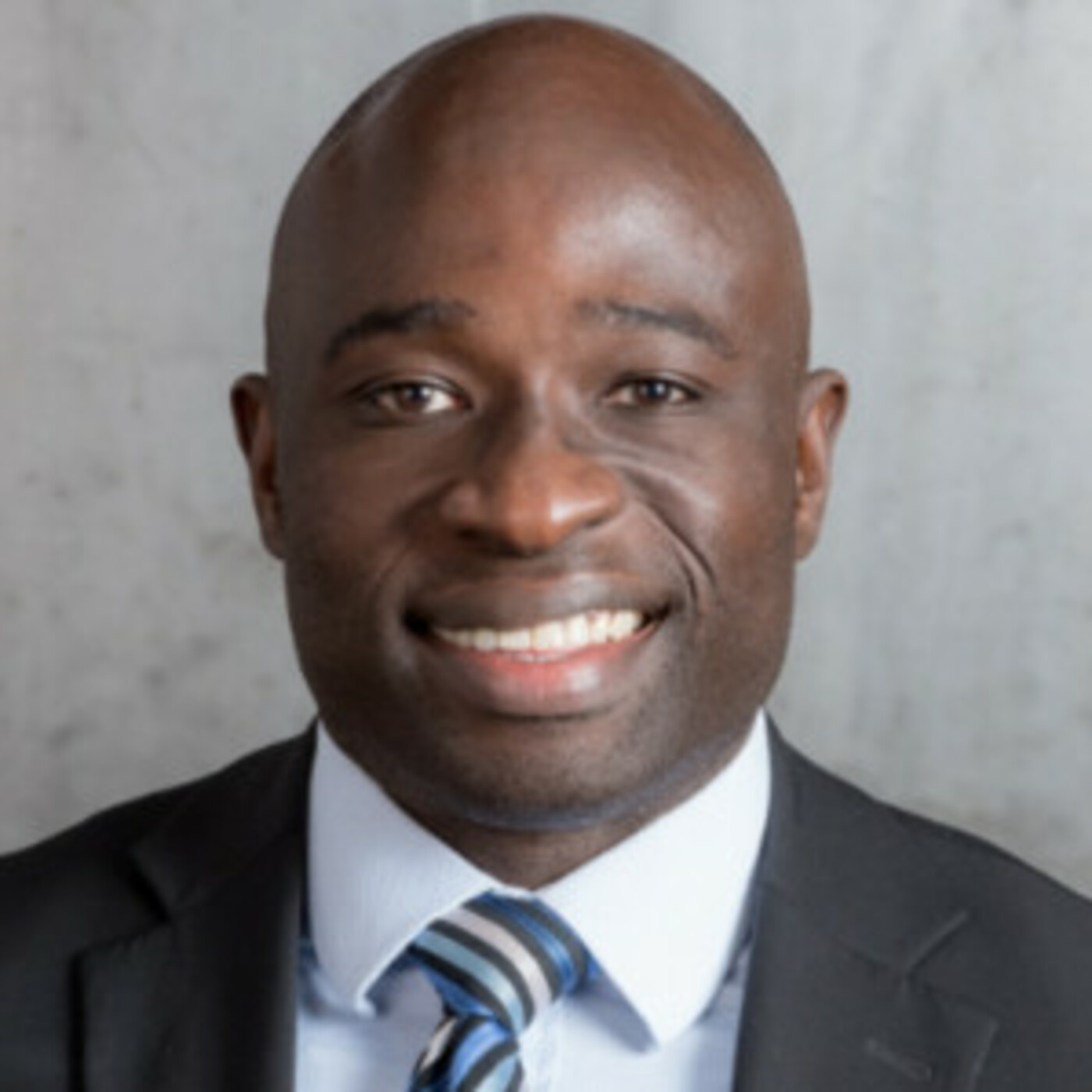
Aoifinn Devitt: When life takes you from Lagos to London to Chicago and back again, what do you learn along the way? And how does this equip you for a career in private wealth? Let’s find out next. I’m Aoifinn Devitt, and welcome to the 50 Faces Podcast, a podcast committed to revealing the richness and diversity of the world of investment by focusing on its people and their stories. I’m joined today by Ayo Ayodele, whom I got to know when he was working as Assistant Treasurer and Deputy Chief Investment Officer at the City of Chicago. He now works in global private wealth management at the Chicago office of AllianceBernstein. And prior to that, worked in a series of investment banking roles servicing African-focused investors, including US family offices and other institutions in Lagos, London, and the USA. He was educated in Nigeria, Harrogate in the UK, and the University of Arizona. Ayo, thank you for joining me today.
Ayo Ayodele: Thank you, Yifan. It’s a pleasure to be here.
Aoifinn Devitt: So Ayo, you’ve had a varied global career to date. What brought you to Chicago, and what ultimately led you to pursue a career in private wealth?
Ayo Ayodele: My journey to Chicago was quite interesting. After starting my career on Wall Street, I moved back to Nigeria during the financial crisis around 2008-2009. At the time, the Nigerian economy was going through a boom. I worked in investment banking, building a client base of US-focused investors in Africa. And right around 2015, the Nigerian economy was going through a recession, so it made more sense to spend more time in the US economy that was growing. I had a good client base of US investors that were investing in Africa, and Chicago was a logical choice because my wife is from here. I got into the City of Chicago where we met right after I moved to Chicago, and the idea behind that was really a burning desire to increase my knowledge and experience based in the investment management industry. Through that experience, I learned asset allocation, making investment decisions as a fiduciary, really ultimately working towards achieving a desired goal for the city of Chicago. My first exposure to private wealth actually was after leaving the city of Chicago. At the time I was working for US-based family offices, institutions, and other investors that had an interest in Africa. A story that really comes to mind was working for a US-based family office that had significant investments in West Africa. That experience following the death of the King Patriarch really exposed me to some of the complexities that having significant wealth amongst multiple jurisdictions had, and this was really what drove my burning desire to start off in the private wealth industry.
Aoifinn Devitt: And what were the key differences between, say, investment banking and private wealth? Is one much more relationship-focused, or are they quite similar?
Ayo Ayodele: There are similarities and certainly there are differences. On the similarities, I’d certainly say that to be effective in both private wealth and investment banking, You need to have a very good pulse on capital markets and the overall economies that you’re working in. As far as the similarities across private wealth and my role at the Treasurer’s Office as an example, liability matching and asset allocation are certainly two key attributes that I think are very important to making sound investment decisions that are aligned with an overall objective. On the differences side, I’d say that banking certainly is a lot more right? So, transactional, you know, as an investment banker, you’re moving from a transaction to the other. And you aren’t necessarily digging and creating really sort of thought-proven deep relationships because, you know, you’re more focused on the transaction. Whereas with private wealth and investment management, I really think there’s a longer-term focus on a desired objective, right? And that really allows you to build long, real, deep relationships with the people you work with. And this was the major reason why I transitioned. Another reason I’d say is with private wealth, it’s a lot more personal, as I mentioned earlier, whereas investment banking, while it can be personal, it’s a lot more sort of institutional. You’re generally working with a corporate or some sort of organization that’s looking to pursue capital, raise capital, make some sort of strategic financing move, and that certainly is a difference. One of the other things about private wealth I’d say, or investment management, is it certainly is long-term focused. I mentioned earlier with the transaction mindset, you’re sort of going from deal to deal, so it’s very short-term focused. With investment management, I’d you say, know, you’re thinking more long-term because, you know, you’re thinking about how money can work for you over an extended period of time to achieve your objectives. I’d say another difference between private wealth and my role in the Treasury Office would be sort of accountability. So while there’s a similarity in being accountable from a fiduciary standpoint, you are serving the people of the city of Chicago or, you know, whatever municipality it is you’re working for when you work in public service from an investment perspective. And then on the private side, you’re accountable to your clients, right? You’re accountable to your clients. You’re on the institutional, you’re working with a specific institution and helping them manage your money. And on the private side, you’re dealing with your clients who might be an individual or an endowment or a foundation.
Aoifinn Devitt: It seems like you think that spending time in public service is quite a good rite of passage maybe for an individual in the investment world.
Ayo Ayodele: Yes, most certainly. I you think, know, for me, working in public service, really understanding how investment decisions really affect how a city functions was very critical, and it really gave me a very sound foundation and an appreciation for making financial plans, asset allocation, and working towards a desired objective.
Aoifinn Devitt: And in terms of the different paths you took in education, what did you find particularly useful for developing your career in investing?
Ayo Ayodele: Quite a number of things. So when I think about education, I think about formal education going through school, and I you know, also, also think about on-the-job education, which some may argue actually is a lot more important than going through school. But from, you know, from a formal education perspective, I’d certainly say that at the foundation level, getting my A-levels in mathematics, economics, and business studies provided me with the requisite skills to embrace finance at the university level. During my time at university, I really appreciated the experience I had with Applied Investment Management and Portfolio Management Theory. I felt this really provided me with a sound foundation in finance and really gave me an opportunity to break into a highly competitive industry. As I mentioned earlier, on-the-job learning, I really think is critically important to successful outcomes and careers, right? Because I think you can’t really replace a case study and having to live either through somebody else’s experience or having having to go through it on your own. And my work experience, I’d say, at leading global financial service institutions, the City of Chicago’s Treasury Department, has given me a good foundation to build on a successful career.
Aoifinn Devitt: And in terms of on-the-job learning, I’m sure in that learning there have been some setbacks, some challenges. Can you talk about any of those and what you learned from them?
Ayo Ayodele: Setbacks and challenges. I would say everybody goes through setbacks. For me, a significant setback is what we are living in now in terms of COVID working in a global role, my expectation at the beginning of the year was really to travel, to meet with clients, to meet with business partners, and really build deeper relationships and sort of opportunities to help people on a global scale. COVID has hit, and now we’re working in a business environment that really requires you to, one, be socially distant, and two, embrace technology in a way that’s efficient to your business development goals. While it has been a challenge adjusting, I’d say you that, know, there certainly have been silver linings. If you as a professional, a global professional, are willing to make adjustments to the time zone you’re working, working more efficiently with technology, I think there’s certainly silver linings there. Other challenges I’d say in my career really perhaps was maybe when I was younger, getting into investment banking at Bank of America at the time. I feel perhaps if I was a little bit better at over-communicating and also learning to balance asking questions versus working hard. Sometimes you have to ask questions to get things done as opposed to trying to figure out on your own. I think those are perhaps some challenges perhaps I faced a little earlier on that really sort of helped me grow because there are definitely silver linings in asking questions and there are definitely silver linings in over-communicating.
Aoifinn Devitt: It’s interesting because you have spent time in Nigeria, and I also spent part of my career in emerging markets. And I do think that spending time in an area that is emerging or frontier can often be quite good in order to force you to think on your feet, to innovate, to not necessarily expect there to be a playbook for every scenario. Would you say that that also made you more nimble perhaps in your approach to your career?
Ayo Ayodele: Most definitely, definitely, yes. I think over the course of my career, having lived in various jurisdictions, various continents, doing various business and economic cycles has been an eye-opening experience. During my time in Nigeria, I think while there were certain sort of silver linings and positives in terms of working in an emerging market that was growing, there certainly were also its challenges. And some of those challenges hindered the ability to experience sort of business growth as you would in a more developed market. That certainly has shifted a lot of my perspectives and how I think about my business and how I think about my profession on a day-to-day basis. Having to make adjustments, having to be nimble, having to be dynamic, I think are some of the skill sets that I definitely picked up through that experience. And I’m sure, you know, you would also appreciate the fact that in emerging markets, while you have a lot of growth opportunity, that sometimes that growth can be limited by by certain domestic challenges. You know, how working through those challenges is definitely a skill set and an appreciation that I was able to capture during my time there.
Aoifinn Devitt: So how difficult is it to build a career in private wealth, to build a Rolodex of contacts? There is a perception that it’s a hard sort of magic circle to break into. How did you approach that?
Ayo Ayodele: Great question. Building a successful career in private wealth takes a lot of hard work, resilience, patience. Okay, you need to spend a lot of time, you need to be very thoughtful about your approach, and you need to have a very good reputation amongst your professional network. It’s very critical. I would say um, perhaps, about to sort of outline what the 3 critical factors needed to be successful in the industry are. One certainly is activity. You need to spend time, you need to dedicate time Within your network, within the community, getting in front of your clients. I think those are very crucial to building a successful career. Another critical factor I’d say is being reliable, being a trusted professional advisor in your contacts is highly, highly critical to build a successful career. Again, and being active in the community. I think I’d say you need to be very active in the community. You need to be known in your ecosystem as an expert because that is really what’s going to help you to drive your business. As far as your question regarding having a Rolodex, you find that people who are able to sort of break in and be successful either have one of two things. Is one, they have the hard work and determination to be successful. Or two, they have the Rolodex along with the hard work and the determination to be successful. For me, you know, I’d say that at the point in which I’d broken into private wealth, I was fortunate enough to have a global set of contacts and experiences that really gave me or gives me the credibility to be able to engage and understand what it is that’s on top of the minds of the people that I do engage with. In private wealth, I’m very fortunate to be able to work with the same type of clients as I did before. However, you know, it certainly comes with its challenges, and that is how the resilience, determination, and the work ethic will set you apart.
Aoifinn Devitt: What are And your views on the current levels of diversity in the investment professions? Do you perceive that things are improving, or what could be done to improve matters further?
Ayo Ayodele: Historically, the investment management industry has not done a good job hiring diverse candidates for several reasons. In recent years, however, there have been some changes, but I would say that a lot of work still needs to be done. During this wave of the pandemic, I think one of the silver linings has been quite a number of social injustice and sort of protests regarding sort of racial and social injustice issues. And this has really increased awareness and openness to you discourse, know, within the investment management industry more than ever before. You find now leading investment firms appear to embrace corporate accountability by taking the necessary steps to sort of demonstrate that they are aware of these issues. There certainly have been signs of improvement. Again, with the increased participation by non-minority colleagues in diverse— diversity-promoting initiatives, I think you find that has generally been improved. You know, you find quite a number of allies They’re looking to advocate to ensure that corporate accountability is certainly applied in corporate settings in the investment management industry. In terms of what can be done to improve the status quo, I’d say that firms really need to be intentional about going outside of their comfort zones and looking at people with diverse backgrounds as people who can contribute diverse perspective to achieve the overall objective of actually growing the business. Because more diverse perspectives leads to more productive results. Data has suggested and proven that many times.
Aoifinn Devitt: Thank you for those thoughts. And when you look at your own career, who were the key people or some key people that influenced you? And were there any pieces of advice that they gave you that you found particularly salient?
Ayo Ayodele: Several people that have influenced me over the course of my career, but I’d say that the most influence that I’ve had in of my career has come from my parents. My parents were both senior finance executives in banking and oil and gas industry. So they imparted knowledge and some of the fundamental business skills required in the business world. But what was most important and what I learned from them growing up was really having a very strong work ethic. Integrity is key. Your name is as good as— having a bad name is having nothing. And accountability. You need to be very accountable, and ultimately, you also need to maintain patience. If you do the right things, good things will ultimately come. Outside of sort of the home front, a gentleman I met in Chicago by the name of Dick Kippart, I’d say, is one of the most influential figures in my career in finance. Dick was a legendary Chicago investor and patriarch of the family, one of the family offices I worked I worked for that was investing in Africa. He had done quite a number of— made quite a number of investments in social impact. He actually invested with Bono, investing and providing access to water, education, and also opportunities for women in West Africa. Dick really helped me understand the softer side of finance and the importance of convincing people to work with you by showing your true character. And that lesson has stuck with me and will continue to stick with me throughout the course of my career.
Aoifinn Devitt: And was there any one piece of advice that you received that you live by today?
Ayo Ayodele: Yes, there are quite a number, but I’d say was if I to think of one from the parents again, I’d say is you need to work very hard, you need to maintain a good name, you need to have integrity, and you also need to give you know, so, you back, know, and give back from a professional standpoint, mentor, or give people access to opportunities once you spot talent. From Dick’s perspective, I’d say Dick again was very big into social impact. One of the key things I’m very passionate about now, even in my role in private wealth, is social impact investing and responsible investing, and investing in a way that is not necessarily focused on achieving a return, but equally focused on achieving positive outcomes humanity and positive outcomes in the world. And working with Dick really was— that was a key lesson that I learned from him was this new social impact, which has now become sort of the buzz and sort of the flavor of the year, or I guess of the decade, is this new concept of responsible investing. But Dick was truly a responsible investor with a social impact focus, and that was a key key lesson that I learned from him that I continue to practice in my life and my professional career today.
Aoifinn Devitt: And one of the objectives of this podcast series is not just to enhance the visibility of a range of faces in finance and to amplify their voices, but also to convey some of what we love about the investment world. So I’m going to end by asking you, what is it you like most about the investment world?
Ayo Ayodele: Oh, quite a number of things I love about the investment world. But I would say that critical things that get me excited are One, there’s never a dull moment, right? So the markets are always shifting based on and, information, you know, there’s always a dislocation at some point or the other. And if you’re a pretty savvy and informed investor, you can take advantage of market dislocations. That I find very interesting. I love working with clients. You know, I you think, know, one of the things I love are people. I’m very much a people person, and this industry really puts you in a position to work with individuals, work with people, and devise sort of strategic plans that are well thought out to help problem solve. And this aspect of the industry I find extremely fascinating. And you also, know, digging deeper on people, I’d say that I find the quality of people that I work with in the industry to be fascinating. You as an example, you’re somebody I met in the investment industry. We maintain a very good corporate relationship. We have similarities and a love for the emerging markets and a love for finance and also a love for Europe. And yeah, just some of the quality people I met, I’ve met, and I continue to meet that are extremely brilliant, extremely exposed, highly cerebral, resourceful, and collaborative to managing successful outcomes for whatever client situation it is that we’re working in.
Aoifinn Devitt: Those are some wonderful insights. Thank you, Ayo. It’s been a pleasure speaking with you today, and thank you for sharing your insights with us.
Ayo Ayodele: Thank you very much for having me.
Aoifinn Devitt: I’m Aoifinn Devitt. Thank you for listening to the 50 Faces podcast. If you liked what you heard and would like to tune in to hear more inspiring investors and their personal journeys, please subscribe on Apple Podcasts or wherever you get your podcasts. This podcast is for informational purposes only and should not be construed as investment advice, and all views are personal and should not be attributed to the organizations and affiliations of the host or any guest.
Aoifinn Devitt: When life takes you from Lagos to London to Chicago and back again, what do you learn along the way? And how does this equip you for a career in private wealth? Let’s find out next. I’m Aoifinn Devitt, and welcome to the 50 Faces Podcast, a podcast committed to revealing the richness and diversity of the world of investment by focusing on its people and their stories. I’m joined today by Ayo Ayodele, whom I got to know when he was working as Assistant Treasurer and Deputy Chief Investment Officer at the City of Chicago. He now works in global private wealth management at the Chicago office of AllianceBernstein. And prior to that, worked in a series of investment banking roles servicing African-focused investors, including US family offices and other institutions in Lagos, London, and the USA. He was educated in Nigeria, Harrogate in the UK, and the University of Arizona. Ayo, thank you for joining me today.
Ayo Ayodele: Thank you, Yifan. It’s a pleasure to be here.
Aoifinn Devitt: So Ayo, you’ve had a varied global career to date. What brought you to Chicago, and what ultimately led you to pursue a career in private wealth?
Ayo Ayodele: My journey to Chicago was quite interesting. After starting my career on Wall Street, I moved back to Nigeria during the financial crisis around 2008-2009. At the time, the Nigerian economy was going through a boom. I worked in investment banking, building a client base of US-focused investors in Africa. And right around 2015, the Nigerian economy was going through a recession, so it made more sense to spend more time in the US economy that was growing. I had a good client base of US investors that were investing in Africa, and Chicago was a logical choice because my wife is from here. I got into the City of Chicago where we met right after I moved to Chicago, and the idea behind that was really a burning desire to increase my knowledge and experience based in the investment management industry. Through that experience, I learned asset allocation, making investment decisions as a fiduciary, really ultimately working towards achieving a desired goal for the city of Chicago. My first exposure to private wealth actually was after leaving the city of Chicago. At the time I was working for US-based family offices, institutions, and other investors that had an interest in Africa. A story that really comes to mind was working for a US-based family office that had significant investments in West Africa. That experience following the death of the King Patriarch really exposed me to some of the complexities that having significant wealth amongst multiple jurisdictions had, and this was really what drove my burning desire to start off in the private wealth industry.
Aoifinn Devitt: And what were the key differences between, say, investment banking and private wealth? Is one much more relationship-focused, or are they quite similar?
Ayo Ayodele: There are similarities and certainly there are differences. On the similarities, I’d certainly say that to be effective in both private wealth and investment banking, You need to have a very good pulse on capital markets and the overall economies that you’re working in. As far as the similarities across private wealth and my role at the Treasurer’s Office as an example, liability matching and asset allocation are certainly two key attributes that I think are very important to making sound investment decisions that are aligned with an overall objective. On the differences side, I’d say that banking certainly is a lot more right? So, transactional, you know, as an investment banker, you’re moving from a transaction to the other. And you aren’t necessarily digging and creating really sort of thought-proven deep relationships because, you know, you’re more focused on the transaction. Whereas with private wealth and investment management, I really think there’s a longer-term focus on a desired objective, right? And that really allows you to build long, real, deep relationships with the people you work with. And this was the major reason why I transitioned. Another reason I’d say is with private wealth, it’s a lot more personal, as I mentioned earlier, whereas investment banking, while it can be personal, it’s a lot more sort of institutional. You’re generally working with a corporate or some sort of organization that’s looking to pursue capital, raise capital, make some sort of strategic financing move, and that certainly is a difference. One of the other things about private wealth I’d say, or investment management, is it certainly is long-term focused. I mentioned earlier with the transaction mindset, you’re sort of going from deal to deal, so it’s very short-term focused. With investment management, I’d you say, know, you’re thinking more long-term because, you know, you’re thinking about how money can work for you over an extended period of time to achieve your objectives. I’d say another difference between private wealth and my role in the Treasury Office would be sort of accountability. So while there’s a similarity in being accountable from a fiduciary standpoint, you are serving the people of the city of Chicago or, you know, whatever municipality it is you’re working for when you work in public service from an investment perspective. And then on the private side, you’re accountable to your clients, right? You’re accountable to your clients. You’re on the institutional, you’re working with a specific institution and helping them manage your money. And on the private side, you’re dealing with your clients who might be an individual or an endowment or a foundation.
Aoifinn Devitt: It seems like you think that spending time in public service is quite a good rite of passage maybe for an individual in the investment world.
Ayo Ayodele: Yes, most certainly. I you think, know, for me, working in public service, really understanding how investment decisions really affect how a city functions was very critical, and it really gave me a very sound foundation and an appreciation for making financial plans, asset allocation, and working towards a desired objective.
Aoifinn Devitt: And in terms of the different paths you took in education, what did you find particularly useful for developing your career in investing?
Ayo Ayodele: Quite a number of things. So when I think about education, I think about formal education going through school, and I you know, also, also think about on-the-job education, which some may argue actually is a lot more important than going through school. But from, you know, from a formal education perspective, I’d certainly say that at the foundation level, getting my A-levels in mathematics, economics, and business studies provided me with the requisite skills to embrace finance at the university level. During my time at university, I really appreciated the experience I had with Applied Investment Management and Portfolio Management Theory. I felt this really provided me with a sound foundation in finance and really gave me an opportunity to break into a highly competitive industry. As I mentioned earlier, on-the-job learning, I really think is critically important to successful outcomes and careers, right? Because I think you can’t really replace a case study and having to live either through somebody else’s experience or having having to go through it on your own. And my work experience, I’d say, at leading global financial service institutions, the City of Chicago’s Treasury Department, has given me a good foundation to build on a successful career.
Aoifinn Devitt: And in terms of on-the-job learning, I’m sure in that learning there have been some setbacks, some challenges. Can you talk about any of those and what you learned from them?
Ayo Ayodele: Setbacks and challenges. I would say everybody goes through setbacks. For me, a significant setback is what we are living in now in terms of COVID working in a global role, my expectation at the beginning of the year was really to travel, to meet with clients, to meet with business partners, and really build deeper relationships and sort of opportunities to help people on a global scale. COVID has hit, and now we’re working in a business environment that really requires you to, one, be socially distant, and two, embrace technology in a way that’s efficient to your business development goals. While it has been a challenge adjusting, I’d say you that, know, there certainly have been silver linings. If you as a professional, a global professional, are willing to make adjustments to the time zone you’re working, working more efficiently with technology, I think there’s certainly silver linings there. Other challenges I’d say in my career really perhaps was maybe when I was younger, getting into investment banking at Bank of America at the time. I feel perhaps if I was a little bit better at over-communicating and also learning to balance asking questions versus working hard. Sometimes you have to ask questions to get things done as opposed to trying to figure out on your own. I think those are perhaps some challenges perhaps I faced a little earlier on that really sort of helped me grow because there are definitely silver linings in asking questions and there are definitely silver linings in over-communicating.
Aoifinn Devitt: It’s interesting because you have spent time in Nigeria, and I also spent part of my career in emerging markets. And I do think that spending time in an area that is emerging or frontier can often be quite good in order to force you to think on your feet, to innovate, to not necessarily expect there to be a playbook for every scenario. Would you say that that also made you more nimble perhaps in your approach to your career?
Ayo Ayodele: Most definitely, definitely, yes. I think over the course of my career, having lived in various jurisdictions, various continents, doing various business and economic cycles has been an eye-opening experience. During my time in Nigeria, I think while there were certain sort of silver linings and positives in terms of working in an emerging market that was growing, there certainly were also its challenges. And some of those challenges hindered the ability to experience sort of business growth as you would in a more developed market. That certainly has shifted a lot of my perspectives and how I think about my business and how I think about my profession on a day-to-day basis. Having to make adjustments, having to be nimble, having to be dynamic, I think are some of the skill sets that I definitely picked up through that experience. And I’m sure, you know, you would also appreciate the fact that in emerging markets, while you have a lot of growth opportunity, that sometimes that growth can be limited by by certain domestic challenges. You know, how working through those challenges is definitely a skill set and an appreciation that I was able to capture during my time there.
Aoifinn Devitt: So how difficult is it to build a career in private wealth, to build a Rolodex of contacts? There is a perception that it’s a hard sort of magic circle to break into. How did you approach that?
Ayo Ayodele: Great question. Building a successful career in private wealth takes a lot of hard work, resilience, patience. Okay, you need to spend a lot of time, you need to be very thoughtful about your approach, and you need to have a very good reputation amongst your professional network. It’s very critical. I would say um, perhaps, about to sort of outline what the 3 critical factors needed to be successful in the industry are. One certainly is activity. You need to spend time, you need to dedicate time Within your network, within the community, getting in front of your clients. I think those are very crucial to building a successful career. Another critical factor I’d say is being reliable, being a trusted professional advisor in your contacts is highly, highly critical to build a successful career. Again, and being active in the community. I think I’d say you need to be very active in the community. You need to be known in your ecosystem as an expert because that is really what’s going to help you to drive your business. As far as your question regarding having a Rolodex, you find that people who are able to sort of break in and be successful either have one of two things. Is one, they have the hard work and determination to be successful. Or two, they have the Rolodex along with the hard work and the determination to be successful. For me, you know, I’d say that at the point in which I’d broken into private wealth, I was fortunate enough to have a global set of contacts and experiences that really gave me or gives me the credibility to be able to engage and understand what it is that’s on top of the minds of the people that I do engage with. In private wealth, I’m very fortunate to be able to work with the same type of clients as I did before. However, you know, it certainly comes with its challenges, and that is how the resilience, determination, and the work ethic will set you apart.
Aoifinn Devitt: What are And your views on the current levels of diversity in the investment professions? Do you perceive that things are improving, or what could be done to improve matters further?
Ayo Ayodele: Historically, the investment management industry has not done a good job hiring diverse candidates for several reasons. In recent years, however, there have been some changes, but I would say that a lot of work still needs to be done. During this wave of the pandemic, I think one of the silver linings has been quite a number of social injustice and sort of protests regarding sort of racial and social injustice issues. And this has really increased awareness and openness to you discourse, know, within the investment management industry more than ever before. You find now leading investment firms appear to embrace corporate accountability by taking the necessary steps to sort of demonstrate that they are aware of these issues. There certainly have been signs of improvement. Again, with the increased participation by non-minority colleagues in diverse— diversity-promoting initiatives, I think you find that has generally been improved. You know, you find quite a number of allies They’re looking to advocate to ensure that corporate accountability is certainly applied in corporate settings in the investment management industry. In terms of what can be done to improve the status quo, I’d say that firms really need to be intentional about going outside of their comfort zones and looking at people with diverse backgrounds as people who can contribute diverse perspective to achieve the overall objective of actually growing the business. Because more diverse perspectives leads to more productive results. Data has suggested and proven that many times.
Aoifinn Devitt: Thank you for those thoughts. And when you look at your own career, who were the key people or some key people that influenced you? And were there any pieces of advice that they gave you that you found particularly salient?
Ayo Ayodele: Several people that have influenced me over the course of my career, but I’d say that the most influence that I’ve had in of my career has come from my parents. My parents were both senior finance executives in banking and oil and gas industry. So they imparted knowledge and some of the fundamental business skills required in the business world. But what was most important and what I learned from them growing up was really having a very strong work ethic. Integrity is key. Your name is as good as— having a bad name is having nothing. And accountability. You need to be very accountable, and ultimately, you also need to maintain patience. If you do the right things, good things will ultimately come. Outside of sort of the home front, a gentleman I met in Chicago by the name of Dick Kippart, I’d say, is one of the most influential figures in my career in finance. Dick was a legendary Chicago investor and patriarch of the family, one of the family offices I worked I worked for that was investing in Africa. He had done quite a number of— made quite a number of investments in social impact. He actually invested with Bono, investing and providing access to water, education, and also opportunities for women in West Africa. Dick really helped me understand the softer side of finance and the importance of convincing people to work with you by showing your true character. And that lesson has stuck with me and will continue to stick with me throughout the course of my career.
Aoifinn Devitt: And was there any one piece of advice that you received that you live by today?
Ayo Ayodele: Yes, there are quite a number, but I’d say was if I to think of one from the parents again, I’d say is you need to work very hard, you need to maintain a good name, you need to have integrity, and you also need to give you know, so, you back, know, and give back from a professional standpoint, mentor, or give people access to opportunities once you spot talent. From Dick’s perspective, I’d say Dick again was very big into social impact. One of the key things I’m very passionate about now, even in my role in private wealth, is social impact investing and responsible investing, and investing in a way that is not necessarily focused on achieving a return, but equally focused on achieving positive outcomes humanity and positive outcomes in the world. And working with Dick really was— that was a key lesson that I learned from him was this new social impact, which has now become sort of the buzz and sort of the flavor of the year, or I guess of the decade, is this new concept of responsible investing. But Dick was truly a responsible investor with a social impact focus, and that was a key key lesson that I learned from him that I continue to practice in my life and my professional career today.
Aoifinn Devitt: And one of the objectives of this podcast series is not just to enhance the visibility of a range of faces in finance and to amplify their voices, but also to convey some of what we love about the investment world. So I’m going to end by asking you, what is it you like most about the investment world?
Ayo Ayodele: Oh, quite a number of things I love about the investment world. But I would say that critical things that get me excited are One, there’s never a dull moment, right? So the markets are always shifting based on and, information, you know, there’s always a dislocation at some point or the other. And if you’re a pretty savvy and informed investor, you can take advantage of market dislocations. That I find very interesting. I love working with clients. You know, I you think, know, one of the things I love are people. I’m very much a people person, and this industry really puts you in a position to work with individuals, work with people, and devise sort of strategic plans that are well thought out to help problem solve. And this aspect of the industry I find extremely fascinating. And you also, know, digging deeper on people, I’d say that I find the quality of people that I work with in the industry to be fascinating. You as an example, you’re somebody I met in the investment industry. We maintain a very good corporate relationship. We have similarities and a love for the emerging markets and a love for finance and also a love for Europe. And yeah, just some of the quality people I met, I’ve met, and I continue to meet that are extremely brilliant, extremely exposed, highly cerebral, resourceful, and collaborative to managing successful outcomes for whatever client situation it is that we’re working in.
Aoifinn Devitt: Those are some wonderful insights. Thank you, Ayo. It’s been a pleasure speaking with you today, and thank you for sharing your insights with us.
Ayo Ayodele: Thank you very much for having me.
Aoifinn Devitt: I’m Aoifinn Devitt. Thank you for listening to the 50 Faces podcast. If you liked what you heard and would like to tune in to hear more inspiring investors and their personal journeys, please subscribe on Apple Podcasts or wherever you get your podcasts. This podcast is for informational purposes only and should not be construed as investment advice, and all views are personal and should not be attributed to the organizations and affiliations of the host or any guest.