



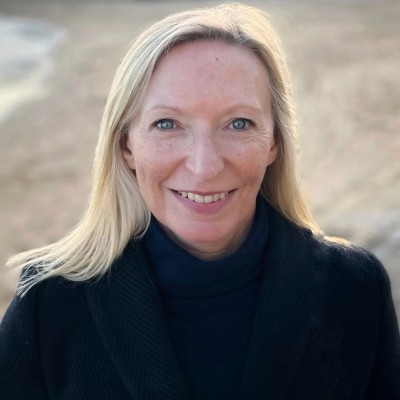
Aoifinn Devitt: This podcast series is brought to you with the kind support of Darwin Alternative Investment Management Limited, which offers innovative, alpha-driven investment solutions that are uncorrelated with traditional asset classes and feature business areas which have not previously been considered by investment funds. The firm aims to create new opportunities for investors to further diversify their portfolios and achieve stable absolute returns. I’m Aoifinn Devitt, and welcome to the 50 Faces Podcast, a podcast committed to revealing the richness and diversity of the world of investment by focusing on its people and their stories. I’m joined today by Charlotte Gibson, who’s a coach, actuary, and pensions consultant. She’s a senior manager at Isio and the founder of The Rewirement, which is focused on redefining retirement through coaching. She previously worked in management at KPMG, and prior to that was an actuarial analyst at Aon Consulting. Welcome, Charlotte, thanks for joining me today.
Charlotte Gibson: Thank you, it’s a pleasure to be here.
Aoifinn Devitt: Well, let’s start by talking about where you grew up, what you studied, and what led to your interest in pensions.
Charlotte Gibson: Yeah, so I grew up in Hitchin in Hertfordshire, which is quite near London, and I had a real passion, I suppose, at school for maths, and I went to university and studied maths and physics. And I think if I’m honest, the reason I did that was I liked the logic of maths. I like the safety that I found in the formulas being right or wrong. And so there was something about the beauty of the rules that it was black or it was white. And I guess I needed that safety. I can’t really think of any other reason why I would have gone to university and studied that, but I did, and I really enjoyed it. And then in my third year at university, you get your careers officer come in and give you a discussion around what do you want to be. When you leave university, and the two that I went to, accountancy and actuarial. And actually, I thought the actuarial discussion sounded really interesting. I’d never ever heard of what an actuary was before, like probably many people today even don’t, but that’s what I chose to be. So I trained to be an actuary, and as part of that, you specialize in an area, and I specialized in pensions.
Aoifinn Devitt: It’s really interesting. I didn’t think of that before, but math of course does give the ultimate closure and a sense of resolution And funny, when I was in university, actuaries were one of the few strands that were guaranteed a job afterwards, so that was always a certain amount of security and closure there. So probably the two are related. Would you say there were any surprising turns over the course of your career and to date?
Charlotte Gibson: So the first 10 years of my career, so started in 2000, first 10 years were fairly standard. So I started as a junior analyst and then progressed really quite quickly through the ranks to senior manager at KPMG. And then in 2010, there was quite a significant couple of events that totally changed everything that I believed in. So, you know, I said I kind of believed in logic and rules, and I taught myself that, you know, you work hard, you get this solution. And in 2010, there was a couple of things that happened that really challenged that. So one was my dad passing away at 57, very suddenly. I was on the way home from work, and I got a call to say he, you know, literally sort dropped down dead from a heart attack. And at the time, I was pregnant with my first child, and that was something that sort of got me through that. And then unfortunately, we lost our baby as well. So there’s two huge, huge events that happened in 2010 that kind of challenged my whole view of the world, and all the rules and beliefs that I had were just thrown out the window. So it was tough. I have to say that KPMG were hugely supportive at the time, And what it meant— so I guess there was two things that kind of emerged for me after all of that. One was that what I valued in my career really changed. So it wasn’t about progressing quickly through the ranks anymore, it was more about the process and enjoying my job, and the variety became really important. And the second was that I was kind of open now to all these possibilities that, that life could throw at me, and, and I wanted to embrace that a bit more than I, than I had before. So I stayed in my job. I still continued as a pensions consultant, and I’m really glad that I did. But alongside that, I took on different roles, and one of the roles that I took on was training to be a coach, a transition coach for women actually coming back into the business after they had been out, um, for maternity leave, which was brilliant. Very different to my day job, very different to the consulting role that I was doing, but it brought a sense of purpose to my job. It was less structured than the consulting role I was doing. Coaching can be, you know, messy at times, but it’s very, very powerful. And I did that alongside my day job, supporting women back into the business. And I think that that probably was quite a turning event in my career because now I was a coach and I was also a pensions consultant, which brought kind of a certain set of skills to me.
Aoifinn Devitt: Very interesting. And we’ll move to speak about the relationship between coaching and how it can help in retirement or rewirement or whatnot. But just since I find it fascinating that it was in finding your own purpose that you sought to give purpose to others. And just on the coaching point, I’ve always found I get so much from coaching. Is it a zero-sum kind of game? Do you find coaches gain from that or does it drain you? How do you find coaching? I suppose, how do you feel when you are a coach?
Charlotte Gibson: I think it’s a real privilege to be a coach, partly because, as you say, I think as you go through coaching training to be a coach, you learn a lot about yourself in terms of how you manage yourself. You’re very aware of your judgments and how you show up for other people, and I’m really privileged to have gone through that. The other bit is the coaching community that you then become part of. It’s a really lovely, often very like-minded group of people that you then become part of your network and That’s meant the world to me since I started that journey. And I think thirdly, it is, as you say, you, you have this sense of purpose. So when you’re in coaching sessions, yes, it can be you giving a lot to that coachee. And I do find that afterwards I do need to take a good hour or so to recharge, because when you’re coaching well, you’re very much in that moment and you’re giving a lot of attention to the coachee. But actually what you get back in terms of a sense of purpose of how you’ve helped them is absolutely worth it. So I think as long as you do look after yourself as a coach and you listen to yourself when you need to recharge, then it is very energizing, it’s uplifting, and yeah, as I say, it’s a privilege to do it.
Aoifinn Devitt: Well, let’s talk now about the origins of The Rewirement. Can you tell us what that is and what your mission there is?
Charlotte Gibson: Yeah, so 18 months ago I set the business up, and it was born out of the desire to, I guess, bring my two worlds together. You know, on the one hand, I’m a pensions consultant and I work a lot with individuals that are trying to understand pensions and financial education, etc. But what I was noticing as part of that is actually that’s one part of it. Absolutely understanding your pension is really important, but the other part of it that was coming up was how scary the retirement transition can be. So, you know, it’s throwing up lots of issues for people. So what am I going to do after I leave my full-time career? What’s my identity now that I’ve left, you know, the label that I’ve given myself? What’s my purpose? There’s so many things that are wrapped up in that that are not just financial. And I saw a lot of parallels to the work I was doing on the transition coaching. So I saw a lot of the models and lots of the skills and techniques that I was working with women coming back into the business, thinking actually there’s lots here that can be taken to the retirement transition to really help people go through that transition, plan for it, be ready for it from a mindset perspective. So I launched The Rewindment to do that, to bring the two together. So to bring coaching skills and coaches to that retirement world and pensions world and, and marry the two together. I called it Rewirement because I couldn’t get away from using the word retirement in some of my branding, even though I don’t like that word because I think it feels quite final. And actually, retirement’s anything but, you know. It’s exciting, it’s the start of something. It might not even be finishing your full-time career or leaving work completely. So I use the word retirement in my literature, but it needs to be rebranded, it needs to be rewired. So that’s where Rewirement was born, in the same way as I think we need to kind of almost rewire our brains when we’re thinking ahead to our retirement so that we can go into that with a sense of energy and vitality.
Aoifinn Devitt: Does this relate to how you say our traditional 3 stages of a working life is changing? Can you maybe just explain what you mean by that?
Charlotte Gibson: Yeah, so I think probably many of your listeners have read The 100-Year Life by Linda Gratton and Andrew Scott, and in that— that book I read quite a number of years ago now— and it really struck me in that, that they make this point that the three-stage life that a lot of us have grown up with, assuming that we’re going to have an education, we’re going to work probably for 40 years, for about 20 to 60-ish, and then we’re going to retire, and that’s the third stage. So education, work, retirement is the typical three-stage life, and I think that is hugely changing. So particularly now in the UK, we’ve got defined benefit pensions are becoming less prominent. So you’re having people retiring in very different ways. People are living a lot longer, which is great on one hand, but it kind of means that that three-stage life doesn’t work anymore for a lot of people, and it’s much more fluid, you know. So you might kind of take sabbaticals partway through your career, you might totally change careers 2, 3, 4 times. And I think society is slowly catching up with that. But actually, if you look at our role models lots of people that have retired recently will have still been doing the sort of more traditional route. So I think that, that we are moving away from that three-stage life, but it’s sort of a transition in a sense that we’re doing that as a society.
Aoifinn Devitt: And if you think about, say, the clients you coach in this rewirement, is there a kind of an average profile? Do you find that people are traveling the world, or are they still doing something involved maybe in their previous career? Are they volunteering? If you were to say, what is a typical retirement today, is that even possible?
Charlotte Gibson: No, I think that’s the point. I don’t think there is a typical retirement nowadays, and I, I’m seeing a trend to people wanting to do some kind of work. So even if they’re moving out of their full-time busy job, how do they get a sense of purpose after that? And it can be through volunteering. So there’s lots of discussions around, can I volunteer Can I do charity work? But also, can I do some part-time, more flexible working that could also bring a bit of income? That’s a sort of a secondary part of it, but it also gives me a purpose and a sense of belonging to a career that can be quite scary to leave behind. So in answer to your question, I don’t think there is a typical way to retire now. I think that’s quite exciting in itself, but it also can be quite overwhelming to people because they haven’t got this well-trodden path anymore that they’re following. But I would say that people are tending to want to stay in work longer, but it to be on a part-time flexible basis and something that they might kind of find enjoyment and energy from, perhaps more than they did so from their full-time jobs.
Aoifinn Devitt: It’s interesting, I’ve used the expression aha moment a lot in this particular series. I think it’s because we think that we know everything there is to know about aging, retirement, and the fact is there’s a lot we don’t know. And I suppose when you work with your clients, do you find anything they learn maybe surprises them about the coaching, maybe about their own potential, about their energy they’re going to have at this stage, what they’re going to want?
Charlotte Gibson: Yeah, I think the most common question is this assumption that they’ve had about their retirement is totally being sort of challenged as part of the work that we do. And I think people are kind of coming to me going, well, I don’t feel like I want to retire, but if I don’t, then what do I do? And I think that’s an interesting discussion. So What we’ll often do is we’ll look back at the career they’ve had. There’s loads of rich data there, you know, about stuff they’ve enjoyed doing, what their strengths are, what’s energized them. And we’ll take all of that learning and then play with it. So, okay, you know this about yourself, you’ve got this really lovely picture of yourself now. How do you want to take that forward? And often they’ll have come with an idea that it’s something very simple, like, I don’t know, retiring and, as you say, moving overseas, and then going ‘But actually, is that going to make me happy? Is that going to make me fulfilled? And if not, how can I design something that does?’ So it’s lovely because there’s been quite a few coachees I can think of that have changed their plans because they’ve realized that’s not going to fulfill them. And I can see that as a real kind of really adding value, because without it, they may have just kind of set— walked into their retirement with the assumption that they had and not been happy. And you do hear a number of stories of people like that, that retire, think it’s going to be wonderful, and aren’t happy in the first few years and sort of waste those healthy years of retirement. So, so that planning ahead, I think, has been really useful for people.
Aoifinn Devitt: And just tied to that sort of modern notion of retirement, I’ve had some guests on other podcast series who’ve spoken about how they have basically decided to do now in their lives what they maybe thought they would always want to do in retirement. Whether that means maybe moving to a farm, moving to the countryside, and they’re learning a new language. Have you seen some of your coachees or people do that?
Charlotte Gibson: That’s a really brilliant point, actually. And what often some of my coachees are people that are thinking about retiring in 10 years’ time, so it’s not an immediate transition, but what they want to do is think about what they can do now to make that future more of a reality. So we often talk about where can you invest your time and your energy to do that. And as part of that, people have talked about, well, how can I experiment now? Because, you know, I’m making an assumption that I want to, you know, live on a farm when I’m 60. How do I know that? How do I know that unless I try it? So what sort of I encourage my coaches to do is, well, experiment now into the constraints that you’ve got. What could you experiment with today? So just as you say, there’ll be people— I had one lady that really wanted to be an ice skating coach when she retired, and she was thinking about waiting until then to do the training. Well, now she’s decided to do it now, so 10 years before, and do it on a part-time basis just to experiment with it. Actually, is that how I want to live that life? So absolutely. And I think that’s kind of quite a, a nice way of bringing that into today. So what can I do today to make that a reality? We’ll experiment and try it, try it out on a smaller level. And that’s been really helpful for a lot of coachees.
Aoifinn Devitt: And it’s interesting because I suppose the norms maybe that prevailed in their thinking maybe were that of the generations before them. And for example, when I look around today, I see many older women not taking on roles maybe of minding grandchildren into their retirement. That’s actually not something that they want to do or that it’s not even feasible to do if children have moved away, et cetera. So do you think society is set up for this new kind of form of retirement as it has evolved?
Charlotte Gibson: I think that there is a lot of work to do and that’s why I find this space really exciting. You know, even if you think about kind of the way we advertise and the way that we market to people that we assume, you know, over 55, over 60, have retired, and how they’re spending their time, I think there’s a lag there in actually what’s happening, happening in reality, how those people actually see themselves and how they’re kind of being marketed to. I think that people are making assumptions about how people want to spend their time. So I think, you know, you’re right that there will be people that want to spend time, more time with grandchildren, but actually That’s not possible for a lot of people. So then therefore, if you take all that away, then, then what is that? So people that are retiring now in this more flexible, fluid way, they’re pioneers, I think. And, and I think, yeah, society hasn’t caught up because we’re almost sort of carving that society out as, as we do that, as we go through that transition, which I think, yeah, why that support, you know, it can be really helpful because you, you don’t necessarily have the role models that you have before.
Aoifinn Devitt: And tied to that, the topic of this podcast series as a main topic is ageism and discrimination against older people in the workplace. If there are some of your coachees perhaps who want to enter or re-enter the workplace or stay there longer, have you seen ageism in practice?
Charlotte Gibson: I think there is this assumption that over a certain age you don’t want to sort of train and upskill and relearn. And I think that actually that does get reflected in the workplace. So lots of the courses and the training will be for people that kind of up and coming through, you know, more junior grades. And I, I think, you know, if you tapped into that really kind of rich, experienced group that are perhaps a bit older, then you could get a lot more from them. But yeah, I think in, in practice at the moment, the resources aren’t spent on training and retraining at that level, and as such, you perhaps don’t get the energy that, that you could do. I think the other problem we’ve got, especially in the financial services industry, is that, as I say, typically people have retired on defined benefit pensions and fairly early. So you’ve got people that have had a really good career in financial services and have retired at 50, 55 entirely and left the industry. So what we’re not seeing is people that are older that are doing that sort of last latter stage of their career in a way that is inspiring. And so I think, again, going back to that sort of lack of role models or lack of visible role models is, is a really important point. And there are some emerging. I spoke to a brilliant guy recently that, you know, had a really kind of quite high-profile job in financial services. He didn’t want to fully retire, but he didn’t want the high stress that he’d had to date. So he took a sabbatical, he took some time to, you know, really think about what it was he wanted, and then he came back into a job at the same firm, different role, probably a lower pressure role, and on a part-time flexible basis. And so if you think about that business, they’ve retained a brilliant guy, but also then the rest of the business is then seeing a, a brilliant energized guy that’s come back and doing some really cool stuff. So I do think it’s changing, but I would say that that example is more the exception than the norm.
Aoifinn Devitt: And I just saw an article in the Wall Street Journal today— here we are at the end of June— about people working into their 80s. Particularly in the financial services industry. So I think it’s starting, the role models are appearing, but yes, slowly but surely. I would love to go back to some personal reflections now. In the work that you’ve done, have there been any highs or lows that you can speak about so far?
Charlotte Gibson: In terms of the retirement coaching, I mean, it’s a fairly new focus for me, so it’s been about 18 months I’ve been doing this. I’d say the high, if I’m honest, is having the confidence to launch the business 18 months ago, and that, that’s a kind of a culmination of support that I’ve had from various people that’s given me that confidence to go and try something. There have been some learning points. It’s a really quite fledgling industry in the UK, so I understand that in the US and Canada retirement coaching is fairly commonplace. So if you said to somebody, if you’ve got a retirement coach, they would know what you meant, whereas over here it’s less so. And so the big part of what I’ve been doing is almost kind of educating or letting people know what coaching is and what career coaching can be, and then how it can apply to the retirement transition. So there have been some sort of like, oh, this is, this is going to take some work moments, not necessarily lows, but just realization that it is quite a big undertaking. But then, you know, that will be peppered with some real highs where I’ve had some brilliant clients that have really appreciated. And as we said before about coaching, kind of bringing stuff to the coach as well, I hold on to those moments and really appreciate them.
Aoifinn Devitt: Well, we’ve had a lot of guests on this podcast who’ve spoken about coaches, more often the traditional type of coach such as sports coach, and they still, you know, decades later are left with some wisdom that that sports coach maybe sowed for them. My last question is around any words of wisdom, creed or motto, advice, maybe whether you give your coachees or that you would give to your younger self. Is there anything that you can leave us with?
Charlotte Gibson: Oh, that’s a lovely question. I think that I guess the main thing that I’ve learned through all of this, through the kind of the low point I talked about in 2010 and also kind of more recently starting the business, is something about trusting the process. And, you know, I talked earlier about wanting there to be rules that you follow, that, that you do follow, and everything’s okay. I think kind of sometimes throwing that out and just simply saying to yourself, trust the process and it will, it will work out, can be really liberating. And it certainly sort of helped me take a few risks recently and embrace that. So yeah, that would be my motto, I suppose, now, is that trust the process and back yourself.
Aoifinn Devitt: Well, thank you so much, Charlotte. I’m seeing someone dedicating themselves now to rewiring of careers and restarting is just such an overwhelmingly positive notion to think of that as an exciting next stage and somehow seems so much more filled with promise than how we might kind of typically conceive of retirement. So thank you for coming here and sharing your wisdom with us.
Charlotte Gibson: Thank you. It’s been a real privilege to talk to you and yeah, thank you for inviting me on.
Aoifinn Devitt: I’m Aoifinn Devitt. Thank you for listening to the 50 Faces Podcast. If you liked what you heard and would like to tune in to hear more inspiring people and their personal journeys, please subscribe on Apple Podcasts or wherever you get your podcasts. This podcast is for informational purposes only and should not be construed as investment advice, and all views are personal and and should not be attributed to the organizations and affiliations of the host or any guest.



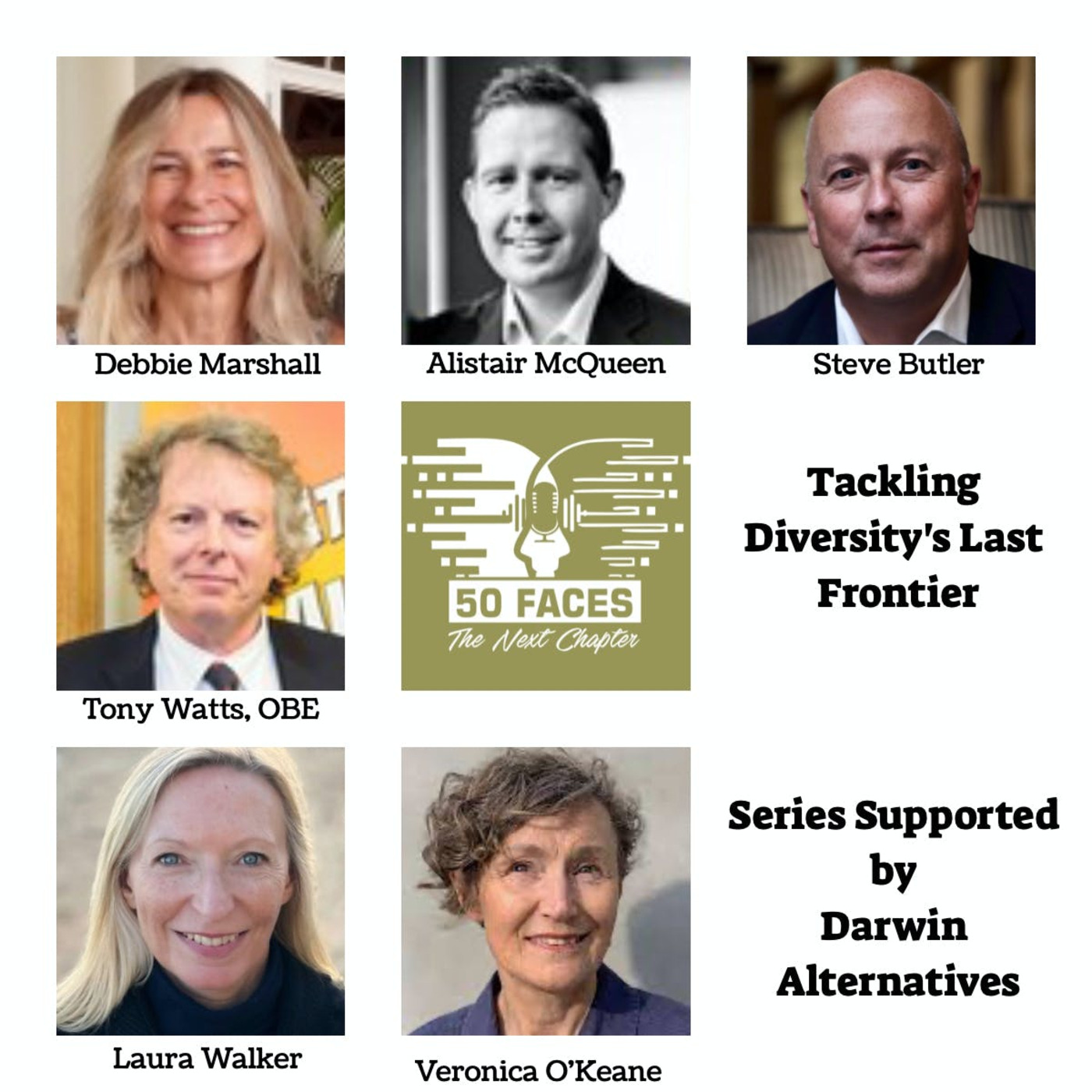
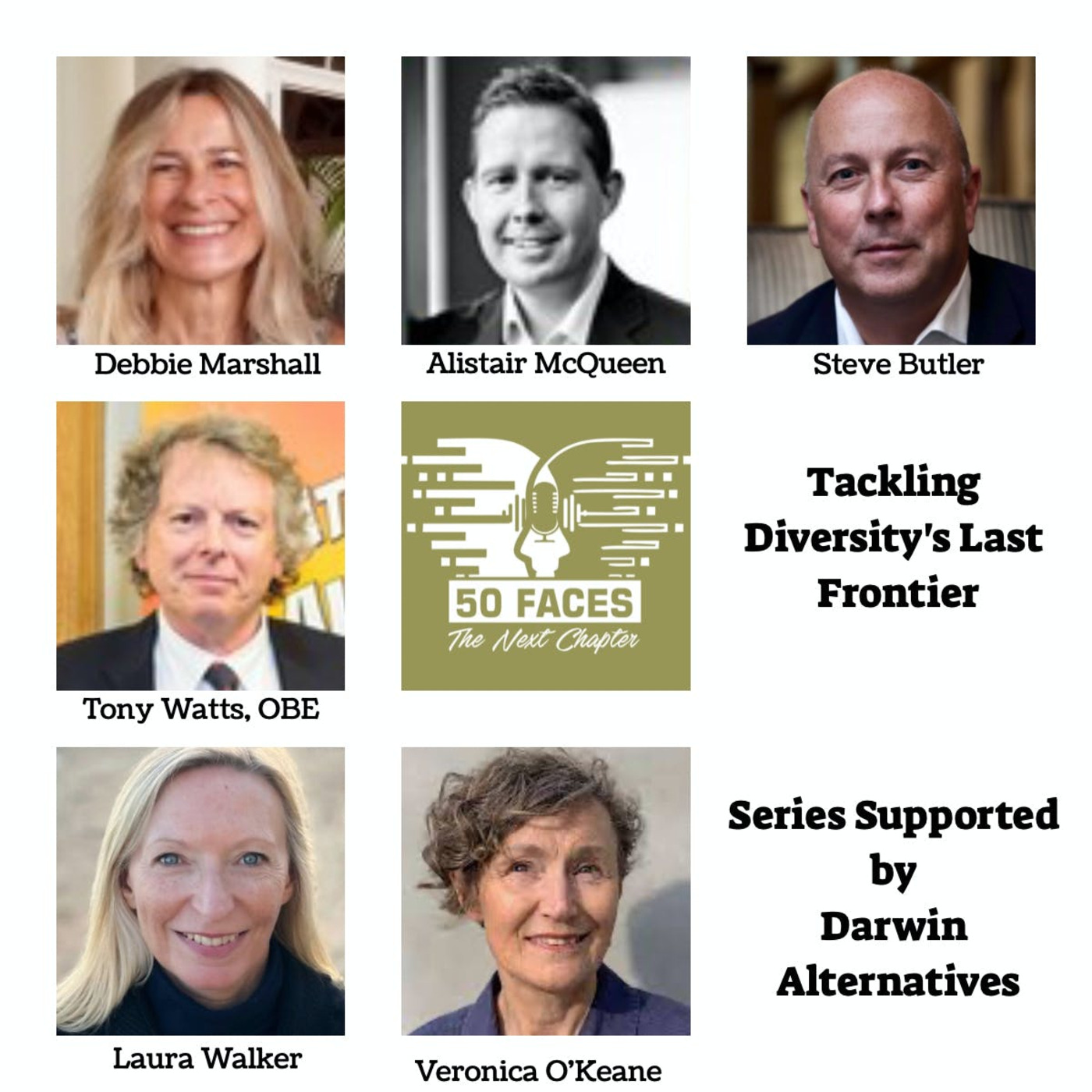
Steve Butler: Is age ever just a number? Last year we launched a podcast with Steve Butler of Pontal Southall Aspire, which shone a light on ageism as one of the last acceptable forms of discrimination. This received such a groundswell of a response that we wanted to dig deeper into this area to develop a special Next Chapter series about the problems of ageism the importance of having access to meaningful, productive work as we age, and some of the barriers, both invisible and visible, that exist in society to this. This focus series looks at the unique challenges of midlife and the growth of interest in the psychology of midlife and beyond. And we hear from Laura Walker, who focuses on this area.
Steve Butler: We are the linchpins of our society, our organizations, and our families. So we are between the the youth and the, and the older age. So the classic sandwich generation, um, comes to mind. So there’s a lot going on, but also we know a lot, we’ve grown a lot, we’ve gathered a lot of skills and experiences along the way. And and the, the research that does exist, which is generally not in the world of coaching but in other areas, points to the multi-directionality of the changes that we’re experiencing in midlife.
Steve Butler: We also look at the obsession with age and some of the deeply entrenched biases that exist around age in popular culture, hearing from Debbie Marshall.
Speaker C: Look at any newspaper article, the first thing it’ll always say is so-and-so, age 59, age 76, grandmother in her 80s. You know, always an age that’s attributed to a person before anything else is described about them. I think it’s just endemic really that age is just prevalent in, in terms of something that is either I don’t know, you’re labeled by it, aren’t you? You’re labeled by your age, and there is a lot of movement about to try and get rid of that.
Steve Butler: We look at some examples of outdated tropes.
Speaker C: If you take birthday cards, for example, for older people, there are some that are really quite offensive, literally treating older people as objects of amusement, and I really don’t think they’re funny at all, and nor do most people who receive them.
Steve Butler: Returning to Steve Butler, we discuss differences in recruiting habits.
Speaker D: So, for example, when you’re recruiting talent into the business, you’ll very easily recruit a graduate without any experience, but when you’re recruiting an older person, you’re being very critical about whether their experience kind of perfectly matches the role that you’re looking for. So I think it requires managers to be much more open-minded in the recruitment, looking at competencies rather than direct experiences, etc. Flexibility is a big part of it for both younger and older workers. I think we’re now entering a world of work where we don’t have to be in the office every day of the week. We can use different methods of working.
Steve Butler: We also look inside some firms which are getting ahead of the curve in embracing and retaining their workforce and hear from Alasdair MacQueen about the midlife review that is now offered to staff.
Speaker E: But when we started speaking to our own people, They were very quick to tell us, wait a minute, my life is way much more than just my money. My life is my career, and my life is my health and my well-being. So we put together a very simple annual checkup, an annual intervention for this population at a voluntary level. Come along if you wish to, where you will be supported, guided, and educated on how to take control of what we call the three Ws of your wealth, your work, and your wellbeing.
Steve Butler: We hear from the founder of Age Action Alliance, Tony Watts OBE, about what has been his life’s work.
Speaker F: I mean, for years was, I I’ve been arguing about making the most of older people’s talents because it’s more fulfilling for those people, but also because many of those people needed to work for longer. And now there’s a national imperative to try and keep these people in work. It’s this othering thing that goes on, you know, groups get othered, you know, so they get looked at differently because they’re not exactly the same as the people making the decisions. And I think there’s an assumption, I feel, that older people have got a sell-by date. I think within the diversity and inclusion area, not just within ageing, but all the other aspects of it as well, and what fascinates me is that everybody’s got something to bring to the party, everyone’s got something different.
Steve Butler: We examine the benefits of cognitive diversity that a diverse group of employees will bring, in particular some of the wisdom that comes from middle age and beyond.
Speaker G: I am a great believer in the ancient wisdom that older people have a wisdom that younger people do not have, and I guess that’s the wisdom that comes with longevity, that you can never make that artificial because a brain that has seen bad things happen, and of course bad things happen to all of us, and a brain that has known that you can get over that and you can get back to a point of being that might even be better than that, a brain that knows that, and a brain that also knows humility, that knows that even if you’re up there and you’ve achieved as much as you ever want to achieve, that that sense of achievement is not going to last. I think that wisdom is worth an awful lot.
Steve Butler: This is an area that currently sits in the shadows of the diversity debate, and we want to bring it out of there. Let’s ensure that all of us can look forward to a future of dignity, purpose, and security.
Speaker E: The embracing of diversity and my personal passion, age diversity, I believe it is the right thing to do for society, but, but for the economy, it’s the right thing to do. Whatever lens you look at it, whatever is your motivation. There’s a huge prize awaiting us if we can embrace age diversity.
Steve Butler: Tune in on Apple Podcasts, Spotify, or all podcast platforms from next week as we kick off the special series. This podcast series is brought to you with the kind support of Darwin Alternative Investment Management Limited. Which offers innovative, alpha-driven investment solutions that are uncorrelated with traditional asset classes and feature business areas which have not previously been considered by investment funds. The firm aims to create new opportunities for investors to further diversify their portfolios and achieve stable absolute returns.
Aoifinn Devitt: This podcast is brought to you with the kind support of Harbourview Equity Partners. Harbourview Equity Partners is a global investment firm focused on opportunities in the entertainment and media space. Founded by Charisse Clocks-Horace, Harbourview is a long-term investor in content with an industrial platform built to protect, optimize, and enhance the legacy of premium IP. With a vision of becoming a true stakeholder in the global value of content, Harbourview believes creators deserve a seat at the table creatively and economically. Owning their narrative, and maximizing value for all. In celebration of our partnership with Harbourview Equity Partners, we have chosen a separate piece of music for each podcast in Series 1. We hope you enjoy it.
Steve Butler: It’s very much left to one side. It’s almost an acceptable form of discrimination. So I think the first thing businesses need to do is acknowledge that age sits alongside gender and race and sexuality and all the other characteristics of D&I. And then think about what the implications are in running their businesses. So, for example, when you’re recruiting talent into the business, you’ll very easily recruit a graduate without any experience. But when you’re recruiting an older person, you’re being very critical about whether their experience kind of perfectly matches the role that you’re looking for.
Aoifinn Devitt: I’m Aoifinn Devitt, and welcome to the 50 Faces podcast. A podcast committed to revealing the richness and diversity of the world of investment by focusing on its people and their stories. I’m joined today by Steve Butler, who’s Chief Executive at Punter Southall Aspire, an investment consulting group. He was previously the founder of Cameradata, a business author, and a visiting industry fellow at Oxford Brookes Business School. He’s a particular focus on areas such as the future of work, older workers, inclusive culture, intergenerational planning, and retirement planning. And writes extensively on those topics on LinkedIn, which is where we met. He’s pursuing a doctorate in business administration, which is examining the effect of COVID-19 on different generations in the workplace. Welcome, Steve. Thanks for joining me today.
Steve Butler: Hi, thank you for inviting me. Well, I grew up in the New Forest, which is a national park in the south of England. Lovely place to grow up. However, I was a bit of a bad student, to be honest with you. I was very distracted, spent a lot of my time rock climbing, mountaineering, sailing. Basically anything that was going to keep me out of the classroom. And I think if I was in the classroom, I was probably looking out the window. So I didn’t go to university. I had a very difficult day one August when the exam results came in before university and got a very dismal set of results. And my parents very pragmatically said, well, that’s fine, don’t be too upset about that, but clearly university isn’t for you and it’s time for you to go out and get a job. I wasn’t expecting that. I was a bit horrified about it all at the time. I thought I would just glide my way into university and kind of carry on as I had been. So I set about looking for work, an advert in the local paper for a trainee business development role with a life assurance and pension company. So I applied for that and to my surprise landed it within a week. And I think probably reflecting on that, I can be honest, it wasn’t my academic credentials that kind of got me that job. I was entering an industry that was very dominated by men in the 1980s. The business that I joined was entirely men in the business development team. So I definitely reflect on that and think, well, that I landed that job because I’m a man. And I think now in my role as CEO, I have to kind of acknowledge that I had a foot up to getting into the industry.
Aoifinn Devitt: And did the fact that you had that awful day, as you describe it, that kind of rude awakening, Do you think that maybe sharpened you up in terms of focus when you got to the workplace? Did you stop cavorting with ponies in the New Forest and sailing and rock climbing?
Steve Butler: Yeah, probably quite perceptive of you to say that. And I think when I arrived in the workplace, it wasn’t what I was expecting. I kind of enjoyed it and I fitted in and it worked for me. So I definitely, in a very short period of time, became much more focused in my career and, and my direction of travel. It didn’t mean I stopped rock climbing and mountaineering, but I did spend my working days working hard.
Aoifinn Devitt: Well, certainly growing up in the New Forest with those ponies, I’m sure, was— that sounds like one of the most idyllic, potentially distracting childhoods. So moving through your career now, were there any surprising turns along that way?
Steve Butler: I think the first surprising turn was that I was actually quite good in a business development role. It wasn’t a career that I’d chosen, it was a career that I landed in. And it worked out really well for me. And I think that’s because I’m a kind of people person. I like spending time with people. I’m quite curious. I like to hear their stories and kind of what works for them. And I think naturally I’m a bit of a problem solver. So I think the combination of those things, as me as an individual, sort of fitted well into that sort of business development role. So in quite a short period of time, I went from a sales area, which was a couple of small towns in the south of England, So within 3 or 4 years later, I had South America as a sales territory. So I was sort of traveling internationally and getting involved with very big accounts and big investments.
Aoifinn Devitt: And was Spanish necessary as part of that journey?
Steve Butler: That’s funny, actually, because my employer said, right, you need to learn Spanish. And I had a Spanish tutor that would come to the office twice a week to teach me Spanish. And on my first trip to Argentina, I arrived at the hotel and the hotel staff wanted to speak to me in English to practice their English. And then I met my first client who said, excellent, can we talk in English because I want to practice? So I came back from that trip and stopped the Spanish lessons because it seemed that everyone I wanted to talk to wanted to do it in English. And as I’ve already said, at that age I was a bit of a lazy academic, so didn’t really have an interest in learning the Spanish.
Aoifinn Devitt: Little did you know, offering them English practice probably was a way in the door on the sales side, so who knows? So now moving, you set up Camera Data. What was the problem that Camera Data was designed to solve?
Steve Butler: Bizarrely, I set Camera Data up in 2003, and people probably won’t believe this, but in 2003, the internet was just taking off as a business tool, and it hadn’t really been actively used much before that. And there was a business process that was going on in the investment world where the big pension schemes were writing very long paper-based sets of questions that they were sending to the investment houses and asking them to complete. And the pension funds were obviously reading these documents and making their investment decisions and then throwing them away and, and starting again the next time they had an investment mandate. So I was able to use the internet to have an online database to allow the investment management firms to upload all their due diligence information and for the institutional pension funds to access that data as and when they needed. So it created quite an efficiency in the marketplace because obviously asset managers weren’t having large teams of graduates filling out paper-based questionnaires, and it made it much easier for the pension funds to track the investment managers that they liked and measure their performance and kind of monitor their performance. So I think I just caught a moment in time. The manager research database at the time was just taking off. In the US market. So InvestorForce had just launched and eVestment had just launched. And I was able to strike a deal with InvestorForce where I white-labeled their product into the European market with a European set of questions and launched the business very quickly and very cheaply. And then over the next 5 years, was able to build out my own tech, was able to secure funding to kind of grow the business, and then was able to branch the business out into analytics and peer group analysis and all the things you expect to find in that sort of service.
Aoifinn Devitt: It’s really interesting. Would you say that any kind of lessons learned in terms of that process of growing, building that business, even though you’d been used to a business development role, when it comes to actually your own business, it can be quite different?
Steve Butler: Yeah, because my previous role to that had been in a blue chip company, and then the next day I was working at home on my own. And you have to deal with everything from changing the printer cartridge to doing the business development, to working with software developers to specify software development. So it was a real sharp learning curve and there was a lot of time spent in the City of London going around convincing asset management firms that it was a good thing. Firms are often slow to change to new technology, so it took some momentum to get going. Over the first 5 years. I started the business, I was only 32, and I’d just finished my MBA. I think the MBA was the thing that made me realize that business isn’t that hard. It gives you a taster of all elements of business, and you think, well, actually, I can apply myself to most of these areas. I think that was what gave me the confidence to do it, and I think I just caught a moment in time right in terms of a need that was there in the market.
Aoifinn Devitt: Did you find there was a need to give some of these services away for free at the beginning, given you were probably a less known name, or did you have any kind of cardinal rules about never undercharging?
Steve Butler: Well, I looked at the marketplace and clearly the asset managers were the ones that had budgets to spend. The asset owners and the consultants were a much harder nut to crack. So I actually built the business on the basis that I would provide the data at no cost to the asset owners and the consultants, because I needed their traction of using the data to attract the managers to sort of get involved in the database. So I built the model for the business up on that basis of where the budget was sitting and which was the easiest to secure.
Aoifinn Devitt: Fascinating. So following the money from a very early, early stage. And I’d love to ask now, finally, just to bring your— this journey, the academic journey up to your current doctorate in business administration. Clearly doesn’t look like you have enough else on your plate. Can you talk about that and how your topic evolved? Because now it seems to be addressing the effect of COVID head-on, which it probably didn’t start out that way.
Steve Butler: No, you’re absolutely right. I’m kind of in my final year now, so I’m sort of 6 years in. And when I started, I started from the perspective as a business leader. I’d been experiencing in the workplace the impact of the different generations arriving in the workplace. I was seeing very different behaviors between my younger employees and my older employees., and that was creating some conflict in, in the workplace. I was also being involved in pensions, very aware of the changing sort of demographics that were going on in the workplace in that people were living longer and because of pension requirements would need to stay in the workplace longer to meet their pension requirements. But that was conflicting against what I was actually seeing against my own peer group who in their 50s were being made redundant or were struggling to find work. So my initial research subject sort of centered around age discrimination and perceived age discrimination in the workplace. And the research before me kind of highlighted that people feel most discriminated against at the beginning and the ends of their careers. And I wanted to test that and see how that worked from a perception of discrimination. And then COVID came along and it was such a significant thing that I couldn’t ignore it. It was impacting on the data that I was collecting. So changed my research subjects to be the impact of COVID on the different generations in the workplace, still looking at how people perceived they were being discriminated against. But I looked at it before COVID and during COVID to see whether there was a kind of difference in the way that people felt they were being treated. And there was. COVID, in fact, has had quite a significant impact on the older workers in their perception of the way that they’re treated. COVID has brought a certain amount of flexibility in terms of where you work and how you work, and that’s benefited older workers. Also, we collectively learned to use the technology together, certainly in the UK. We weren’t using Microsoft Teams or Zoom before COVID and we all collectively learned how to use it together and made the mistakes together. So some of the stereotypes around older workers not being not very good at technology were kind of overcome by this collective learning together through the period. So, from the perspective I’m looking, COVID has had a positive impact in the workplace.
Aoifinn Devitt: Really interesting. I’d love to dig into something maybe that initiated this whole DBA at the beginning. You said there were very specific differences in the way perhaps different generations were presenting at the workplace, and that was leading to some tension. What were those kind of differences?
Steve Butler: Yeah, so, so I had an older cohort that had behaved in the workplace the same for the previous 30 or so years, which meant wearing a suit to work, coming to work 9 to 5 in the office, having a kind of bureaucratic team structure around them. And then a younger cohort that were coming into the workplace saying, well, I don’t actually have to be in the office all the time. It doesn’t matter whether I’m in the office or in a coffee shop at home, I can still do the same amount of work. I don’t need to be working 9 to 5. I can break off in the middle of the day and do something else and do the work later. I don’t have to wear a suit and tie. I don’t have to use email to communicate. I can use other methods of kind of communication. So there’s just by virtue of the fact that you had a cohort that had behaved in a certain way for a long time and a new generation coming in with a different set of expectations caused you problems, know, right down to sitting in a meeting together and half the group have got their laptops open in front of them and half of them haven’t. And they’re thinking it’s rude because people are looking at their laptops rather than looking at them. So all these examples of how the different ages behave differently. So I’ve spent a lot of time in the last 5 years sort of trialing in Eric management techniques to see, well, how can I get these groups to work together more productively?
Aoifinn Devitt: So interesting because obviously communication, I would think, about expectations, meeting expectations, etc., just trying to put oneself in the other’s shoes could go a long way towards some of this. But I do find it quite soul-destroying, I suppose, to hear about that circle, that full circle of discrimination coming full circle towards the end of one’s career. Even if COVID has improved the situation, I would imagine it’s still existing, this discrimination. How can we start to tackle that?
Steve Butler: Well, I think firstly, age is the one D&I characteristic which kind of isn’t on the, on the main agenda. It’s very much left to one side. It’s almost an acceptable form of discrimination. So I think the first thing businesses need to do is acknowledge that age sits alongside gender and race and sexuality and all the other characteristics of D&I, and then think about what the implications are in running their businesses. So, for example, when you’re recruiting talent into the business, you’ll very easily recruit a graduate without any experience. But when you’re recruiting an older person, you’re being very critical about whether their experience kind of perfectly matches the role that you’re looking for. So I think it requires managers to be much more open-minded in the recruitment, looking at competencies rather than direct experiences, etc. And I think flexibility is a big part of it for both younger and older workers. I think we’re now entering a world of work where we don’t have to be in the office every day of the week. We can work from home some days of the week. We can dress differently. We can use different methods of working. And I think it’s also about creating a culture where you’re not just saying, well, your older workers, they’re not really keen on promotion or training opportunities. You know, we need to treat the whole workforce the same from that perspective. If we don’t do that, people will leave the workforce and kind of not come back. And I think that’s what we’re seeing. We saw lots of people, older people in the UK, leave the workforce during the COVID period because they got a taste of what retirement would be like. And they liked it, and the frustrations that they had in the workplace weren’t being addressed.
Aoifinn Devitt: In terms of addressing this with initiatives, you mentioned diversity initiatives, so many of them, whether it be internship programs, awareness sessions, anti-bias training. How can we address this? And unfortunately, it seems that it is particularly maybe weighted— I don’t know whether it’s less favorable to men because there’s a desire to still, for example, on board positions, have more women in roles. Is it falling differently on men and women, this discrimination?
Steve Butler: Well, that’s quite interesting because in the pilot study for my doctorate, I looked at the intersectionality of age and gender, and what I found matched the kind of research that had previously existed is that men, from a perception perspective, feel most discriminated against at the beginning of their career because they’re coming into the workplace new, everyone’s older than them, they don’t know the lay of the land, etc. But that kind of tails off quite quickly. And then it starts to build in the latter part of their career. Now, this is in contrast to women who predominantly have a perception of being discriminated against equally throughout their entire career. So there is a gender difference here.
Aoifinn Devitt: Another so destroying comment from you that I have now to thank you for. Discriminated against across their entire career. Well, that I suppose it’s at least it’s consistent. In terms of the industry in general now that we’re looking at, I mean, let’s give it a score. So I know that you’ve done this longitudinal study and you’ve shown that there is unfortunately not much progress. There’s a lot of talk of progress, the talk of initiatives that I mentioned before. How would you assess the efficacy, the likely efficacy of some of these initiatives?
Steve Butler: Yeah, I mean, I have to say I would score the investment and savings industry in the UK market low. I would give it a 2 or a 3 out of 10. We have an industry that is very male-dominated with men from very specific universities, etc. And that’s cascaded throughout the years for many decades. There’s a desire for things to change, and we’ve established a cross-industry initiative called the Diversity Project in the UK. There’s almost 100 member firms involved in that initiative, and it’s been running for 5 years and it’s got workstreams in all the different areas of diversity and inclusion. And produces huge volumes of content, events, charters, manifestos, etc. But we’ve barely seen the needle move in 5 years. So it’s frustrating. I acknowledge that it will be slow to change, and a lot of the change is going to come from attracting new talent into the industry, new, more diverse talent, and creating a culture where those individuals can thrive and, and kind of stay in the industry. So there’s some great initiatives around 10,000 Black Interns and social mobility charities supporting people to get roles in the investment industry. So I’m kind of very optimistic about the future. I’m just super frustrated at the speed at which we’re able to make an impact.
Aoifinn Devitt: And is there any difference in the kind of traction your stream is getting versus, say, some of the other streams?
Steve Butler: No, I don’t think so. I’m not seeing huge traction in any of the streams. The only area where I have seen traction is we have a work stream that I’m actually the executive sponsor for, which is smart working, so hybrid working. And pre-COVID, trying to convince my CEO peers in the investment industry that hybrid working was a positive thing and would have a very positive impact on many people in the workforce, they weren’t really engaging. But then obviously COVID’s happened and it’s transformed the workplace. So we’ve done 10 years forward almost on that front. My only concern is that companies revert back to the way that they were because that’s what they know, rather than embrace the future and acknowledge that if you do allow flexible working, you have a much larger talent pool available to recruit from. You’re creating an environment which accommodates people as their needs change. So I’m a big supporter of hybrid working and I hope we can kind of maintain that as we carry on post the COVID years.
Aoifinn Devitt: And it’s interesting because obviously participation is still painfully low in the workforce in the whole, which is giving rise to some of this, this crunch. So maybe— and it’s also, of course, been more pronounced in the 55+ age groups with the dropping out of the workforce. So maybe that’s an issue that we can try to address through— and returnships exist for professionals mid-career often that have left for various reasons, parental leave, etc. Maybe a similar type of returnship for older generation might be suitable? Have you seen anything work like that?
Steve Butler: Yeah, I have, and there are some initiatives in the industry, and I think it’s a bit of a change in mindset. I think historically we’ve always felt recruitment happens at the graduate stage rather than a kind of returning stage, but I think as that mindset changes, it will have an impact. And it’s not just age-related, it’s gender-related, it’s neurodiversity-related, etc. It will have a positive impact in a number of areas.
Aoifinn Devitt: We’ll just move to now, back to your personal story. You’ve had a career that’s spanned some few decades. What would you say are some of the, sorry, not to underscore, but I’m in a similar situation myself, so that isn’t a soul-destroying thing. What would you say there were some highs and lows of that that you can tell us about?
Steve Butler: Yeah, I think for me personally, I found the corporate world in the larger investment houses challenging. And I think for the same reason I’m finding it challenging when I talk to them about diversity and inclusion. So for me, the highlight was when I stepped away from the blue-chip organizations and kind of set up on my own and allowed myself to build a business in the structure and the frame that I wanted it to be, to my own values rather than the values of those organizations. So for me, that was a big turning point in my life and my career, to work for an organization that has my values.
Aoifinn Devitt: That’s so interesting. And you talk about your values. Would you say that any of those were influenced by mentors that you had or key people?
Steve Butler: Yes. And my current chairman, Jonathan Punter, is probably an individual who I’d say that’s influenced me significantly. I believe he’s invested in me rather than the business. So he’s kind of looking at me as someone with a set of competencies rather than any particular business decision. He’s taken a long-term investor perspective on building the business. Because he understands the investment industry, he knows that there are highs and lows and that mistakes will be made, and he’s been prepared to invest on the longer term and be pragmatic. So I think that combination of investing in the person, pragmatism, and accepting the highs and lows of the market are a set of skills that he has that certainly have influenced me and influenced the way that I look at businesses, investments, etc., personally.
Aoifinn Devitt: It’s interesting, actually, that brings up another question around the particular importance of that kind of longer memory in a time like now when we are perhaps a decade or two away from a similar regime to what we’re experiencing today. So whereas many of the workforce have actually never lived through circumstances like we’re in, rising rates, high inflation, isn’t this now more than ever that we should be looking to people with more experience in these type of markets because they’ve simply seen it before, they can imagine it?
Steve Butler: Absolutely. And I think they’re able to hold their nerve and be pragmatic that we’ll come out the other side. Certainly when I look back at my younger career, you get very nervous when there’s a crash or a bubble, etc., about what the future is going to hold. So certainly that older cohort is going to bring that pragmatism and confidence to see us through some of these challenges. So I think when we think about older workers, it’s not always about a straight linear career. There are lots of things that people can contribute to the business in terms of mentoring and coaching and having that corporate memory, which are hugely valuable to the organization. And they’re not directly linked to a straight linear career.
Aoifinn Devitt: And when someone’s had a long career, we often associate it with great words of wisdom that they’ve picked up along the way. Are there any that you’ve picked up or any creed or motto that you live by?
Steve Butler: Well, I think for me, You might expect me to say this from someone that established the Camera Data business, but doing your due diligence and understanding the detail of what you are doing is kind of really important. When I think back to my early career and I worked for some of those blue-chip kind of investment houses and I promoted their investment products, in all honesty, as the business development person, I didn’t necessarily understand those investment products as well as I should have done. And the company certainly didn’t tell me all the details. And things happen, funds didn’t perform, and you wonder, well, why didn’t they perform? And you kind of think, well, if I’d done my due diligence at the start, I would’ve known the strengths and weaknesses of these funds, and I would’ve sold them in a different way. Certainly in my early career, there was a smooth bonus fund with a headline rate that I sold lots of. And then when markets turned bad, they implemented a market value adjustment under the actuarial discretion clause, which I had not read and didn’t know anything about. So for me now, looking back, I think do your due diligence on whatever it is, whether it’s an investment fund, a job, a company. I think in the past, I’ve always jumped in with two feet and perhaps haven’t done the due diligence that I should have done.
Aoifinn Devitt: It’s also getting back to the why. I mean, why are we here? Why are these products here? The question I asked you, what is the problem that it’s designed to solve? Can sometimes be a helpful reminder that we’re not just operating in a vacuum. Thank you so much, Steve. This has been, first of all, I came across you because you were shining a light on a topic that I think gets far too little discussion. Unfortunately, ageism or discrimination or non-inclusion of older workers is something that is very rarely discussed precisely because those workers may have other issues that compound this problem. They may be at a stage of their life that they’re less healthy, less active, and have other issues that perhaps complicate advocating for themselves. So thank you for the work you do through the Diversity Project and on your own to shine a light on this and for keeping us talking about this because we’re all getting older and we’re all going to need advocates like you.
Steve Butler: Absolutely. That’s the thing. We’re all getting older. Thank you. And, and I appreciate the conversation.
Aoifinn Devitt: I’m Aoifinn Devitt. Thank you for listening to the 50 Faces Podcast. If you liked what you heard and would like to tune in to hear more inspiring investors and their personal journeys, Please subscribe on Apple Podcasts or wherever you get your podcasts. This podcast is for informational purposes only and should not be construed as investment advice, and all views are personal and should not be attributed to the organizations and affiliations of the host or any guest.

Aoifinn Devitt: This podcast series is brought to you with the kind support of Darwin Alternative Investment Management Limited, which offers innovative, alpha-driven investment solutions that are uncorrelated with traditional asset classes and feature business areas which have not previously been considered by investment funds. The firm aims to create new opportunities for investors to further diversify their portfolios and achieve stable absolute returns. I’m Aoifinn Devitt, and welcome to this special 50 Faces Focus Series, The Next Chapter, focusing on portfolio careers. In each episode, Throughout the episode of this 4-part series, we will hear from seasoned professionals about what it takes to be an effective board or committee member and chair, and we will share some nuggets of their wisdom for careers and life. Our last episode in this collection takes us primarily to the US and the Middle East, where we meet with some seasoned as well as newer directors to hear their thoughts on the evolution of the role and the power of diversity. First, we hear from Jan Nicholson, president of 2 private family foundations, the Nicholson Foundation in New Jersey and the Grable Foundation in Pittsburgh, Pennsylvania. Jan recently retired from a board role at MDRC, which is where we met, and we had the pleasure of sitting on the investment committee together there. Jan is in the process of winding down a family foundation, the Nicholson Foundation, that has been focused on improving the health and wellbeing of vulnerable families in New Jersey through changing the systems that serve them. She has an extensive background in finance, having worked at Citibank and follow-on firms for 25 years. She’s held board positions at Rubbermaid, Ball Corporation, and Radian Group from 1990 to 2015. I asked her about how her investment experience had fed into her board roles.
Jan Nicholson: At Grable and at Nicholson, I am the one person on the board, the one person responsible for oversight that understands investing in the financial markets. In Pittsburgh, we have a model that’s almost like an outsourced CIO. So my role there is to watch and question and follow advice, but occasionally take exception. At Nicholson, I manage the money with— I’ve had some wise advice along the way, but I’ve been hands-on at Nicholson.
Aoifinn Devitt: I asked Jan about what she thought was key to being a long-term effective board member.
Jan Nicholson: I think it’s important to understand the business, and one of my 3 boards was a mortgage insurance company that had bought a bond insurer that may have represented 10% of the value of the company. And no one on that board understood the bond insurance business, and that’s why they brought me on, because I did. And of course, that company went through a crisis in 2008-09, and it turned out that the decisions we made with respect to our bond insurance business were critical for our surviving through that difficult time. And we were able to make the right decisions because we had someone on the board who knew the business. Otherwise, you know, Goldman was trying to buy it cheap from us, and I knew it was too cheap. So I feel that that’s when you can really add value if you understand a business. And my other two board positions were manufacturing businesses. And I’d come up through a finance business, so I didn’t feel that I added the same value on the other two boards. However, in those other two companies, I chaired the audit committee, and there I think I did add value in that role. You know, for anybody listening, you know that you’ve probably felt that if you’re working at a company that the board doesn’t really know what’s going on down in the ranks because the leaders of the company, of course, are managing what the board hears. And knowing that, you know, sitting on a board, remembering that feeling that there are things going on down there under the surface of the sea that don’t come to the surface. I would use my time chairing the audit committee to ask questions and listen, and even I learned things that it was valuable to know that I could share with the board that otherwise wouldn’t have come to light. It was a bit of a battle because captains of industry, the other people on the board, like to be efficient and keep meetings moving, and they don’t have patience with what appears to be wasting time. When you ask staffers at a company questions, you have to sit and listen and follow up with more questions to have things begin to flow. And it’s hard to do that when you have a limited amount of time to accomplish what you need to accomplish for a board meeting. You have to be a little stubborn. But in doing that, I thought I did contribute to both those companies.
Aoifinn Devitt: This was fascinating that she highlighted the importance of really digging in to see what’s going on in the weeds. It made me think that right now, given how scattered and distributed around the world workers and back offices are, that our scenario of working remotely might make that digging into the weeds even harder. Finally, I asked Jan her advice for living well.
Jan Nicholson: I remember my grandfather saying, and that is, if something is worth doing, it’s worth doing graciously.
Aoifinn Devitt: Staying in the US, we spoke with Dennis Archer in our Inspiring People in the Law series. Dennis was a judge in the Michigan Supreme Court and was mayor of Detroit from 1994 to 2001. He was the first Black head of the American Bar Association. He is currently chairman emeritus at Dickinson Wright, a Detroit law firm. In addition to multiple committee and board roles. I sat down with him to discuss his early upbringing, his journey into law, his time with the Michigan Supreme Court, and why he ran for the mayor of Detroit. He talked about his professional life and how he is compelled to give back.
Speaker C: I’ve spent my professional life trying to open up doors for people around me. I am ambitious, otherwise I would not have been a successful lawyer, would not have been elected to positions of presidents of bar associations, of chairman of a major and outstanding chamber of commerce, elected to board of directors, public and trade companies, and more, unless I had something to offer. But I didn’t want me to be the only one because what we are seeing those of us who have been privileged to serve on corporate boards, is that it’s like one and done. For women, maybe one and done, but let me just put it this way. When you take a look at women on corporate boards, there have been a number of studies that have confirmed that corporate boards who had women as a board member, those corporate boards return better shareholder value than those corporate boards with no women at all. Which means that when you have women, and when you have people of color on corporate boards, the corporate boards gets the benefit of the thinking and the knowledge base, and things that make a difference in the lives, that makes it better for a corporation to compete with other corporations around the world or in the United States. And so I think that there’s a recognition that that is occurring and that you lose when you don’t have the contributions and the ability that women have demonstrated in leadership. I am looking for a brighter future for our United States, and my thing is, personally, Remember I said I’m sort of ambitious? I pull myself up the ladder or whatever with my left hand. That’s my weakest hand. I use my right hand or right arm to reach behind me and to pull and slingshot ahead of me everybody that I can to cause them to have a better life than me, etc.
Aoifinn Devitt: Another U.S.-based advocate for diversity and inclusion is Gerald Chan-Young. Gerald is Principal and Chief Investment Officer at GCY Associates, which provides consulting and advisory services based in Washington, DC. He has over 25 years of experience as a Chief Investment Officer, 14 years of which were spent as Vice President and Chief Investment Officer of the United Negro College Fund. He previously held a range of financial services roles, including roles at UBS, PaineWebber, and Riggs National Bank in various capacities. I asked Gerald what he seeks to bring to his professional work and director roles in particular.
Speaker D: I hope to bring a sort of eclectic mix of educational and work experiences, and I should say a global eclectic mix of education and work experiences, and I hope to add to the Alpha component of whatever their missions are. So if the mission is pure profit maximization, then I hope my contribution aids in that cause. If the mission is broader than just pecuniary, then I hope to add to that cause as well. And I’ve had the good fortune of working with different types of institutions, including an Ivy League university that I’ve advised on. I’ve also advised on a smaller university I’ve worked with a multilateral based in Europe, in Switzerland. I worked with them a couple of years, in fact. And the current roles that I have— I serve on the board of a hedge fund group of companies. I serve on the boards of a group of insurance companies as well. And in fact, I chair the investment committee for that insurance group. And so again, what I hope to bring is that global/international, eclectic, meaning varied mix of education and work experiences, to increase the alpha component of whatever their primary mission is.
Aoifinn Devitt: He has had an extraordinary career, but any career comes with highs and lows. Gerald was very open about areas in which he wishes he had pushed harder for change.
Speaker D: I could have been more inclusive in formulating investment strategies, especially at the nonprofit UNCF. Most of my work tended to be through the triangular structure of the investment committee, the outside consultants, and accompanying custodians, individual managers, etc., etc. So one prong being the fiduciary governing body, the IC, the other prong being the third parties, the outside managers, the custodians, the advisors, etc., etc. And the third prong being the internal power structure and hierarchy at UNCF. And I think if I had a chance to do it again, I’d have worked harder on making that third prong a little more present, especially in the formulating of investment ideas and strategies. I know some of our positions became slightly arcane, and there was an element of that as well. Because as I’m sure you well know, it’s a little bit more than just financial literacy. I mean, some of the strategies, especially in the modern era where you have unconstrained mandates, really get into the realm of arcana. And I could have— I don’t say been more pedagogical, but I could have made more effort to bring in the team at UNCF to make them a more inclusive active part in the investment management strategizing and execution.
Aoifinn Devitt: The interview with Gerald was a joyful one, and his parting words for us were a reminder that happiness is a choice, so you choose. Gerald introduced me to Rania Azmi, who’s the founder of Alexandrite Decisions, a NATO-registered management consultancy and training firm that fuses her three interests of investment strategy, academia, and cancer patient advocacy. Rania is based in Kuwait and was a strategic advisor to the Kuwait Sovereign Wealth Fund for over 10 years. She’s also a member of the Executive Education Board at the Wharton School of the University of Pennsylvania. And one of her particular academic interests is decision-making. Rania’s full interview will feature in the 2022 50 Faces podcast, but I wanted to first share some of her insights on a portfolio career. I asked her what she brings to her director roles.
Speaker E: I would say always think outside the box. Always try to bring something new, and new not into having a trending or something in fashion, new as to try to make the life of your constituents easier. Whether it’s a charity board membership or it’s a business one or related to academia or the industry, you are there to provide a sounding board to provide good guidance or to support the decision-making. So it would be very helpful to get your records straight. Try to be informed yourself and up to date for the happenings. And try, as I said earlier, to navigate the noise providing direction. So we all see these trends, and I call it switch-on society. We are always switched on, and I’m not going to mention what types of devices, but we are always switched on in terms of news and trends and things happening in the world. But these, if we cannot draw patterns or trends or even analytics of these huge information flow of information, they will be of no use. And worst yet, they can provide confusing signals. So the key role for any board or leader or business director is to provide that direction based in informed, I would call it evidence-based or credible information that you process them one way or another to give you that direction instead of noise.
Aoifinn Devitt: Finally, we meet with Kimberly Smith, who, like Rania, will feature in the 2022 50 Faces podcast. Kim is head of capital formation at Techstars. She was previously director of marketing and investor relations at Owl Creek Asset Management, and before that worked with Davidson Kempner and ABN Amro. She holds a number of board roles and is an active advocate for education. Kim also talked about the current diversity push and how to ensure that it is genuine and effects lasting change, as well as the tone she tries to set in her board roles.
Speaker F: I think that there’s sometimes, you know, now with this diversity push where people, some people are super into it and really understand the importance of having women and minorities on boards and how their diverse voice will help them succeed. But I think to your point, there are also people that want women and minorities on boards for diversity’s sake and don’t want them to opine on issues. And that’s not going to work. That’s not going to be successful for any organization that wants to succeed in the long term. Because if someone is committed to being on a board, their voice matters. And every voice should matter. And I do notice that sometimes. I also notice sometimes that women either maybe they are yes, like they feel like they need to yes, or they’re afraid to speak. And one of the things I’ve noticed often, particularly early in my board roles, is that sometimes women get talked over and interrupted. One of the things I do at the start of board meetings is I lay ground rules. And I know, I’m sure there’s some backchanneling texts that probably call me mom, and I’ll own that title and I’ll wear it very proudly. But I always say, we are here for a reason. Everybody has a voice at this table, and do not interrupt when people are speaking. Wait your turn. Everybody will have a turn. And if people do interrupt, I will interrupt them. But I do that intentionally because otherwise people start to talk over each other and the message gets diluted. And I think it’s really important that everybody, regardless of gender and race, gets a seat at the table, that has a seat at the table, gets a voice at the table, because those are two different things. Having a seat at the table is important, but having a voice at the table is equally important. And I really try to set the tone. At my board work.
Aoifinn Devitt: Setting the tone, starting as we mean to continue. I hope that you found these insights useful across the Next Chapter series. Follow us on LinkedIn, Twitter, Apple Podcasts, Spotify, or wherever you get your podcasts. This podcast is for informational purposes only and should not be construed as investment advice, and all views are personal and should not be attributed to the organizations and affiliations of the host or any guest.
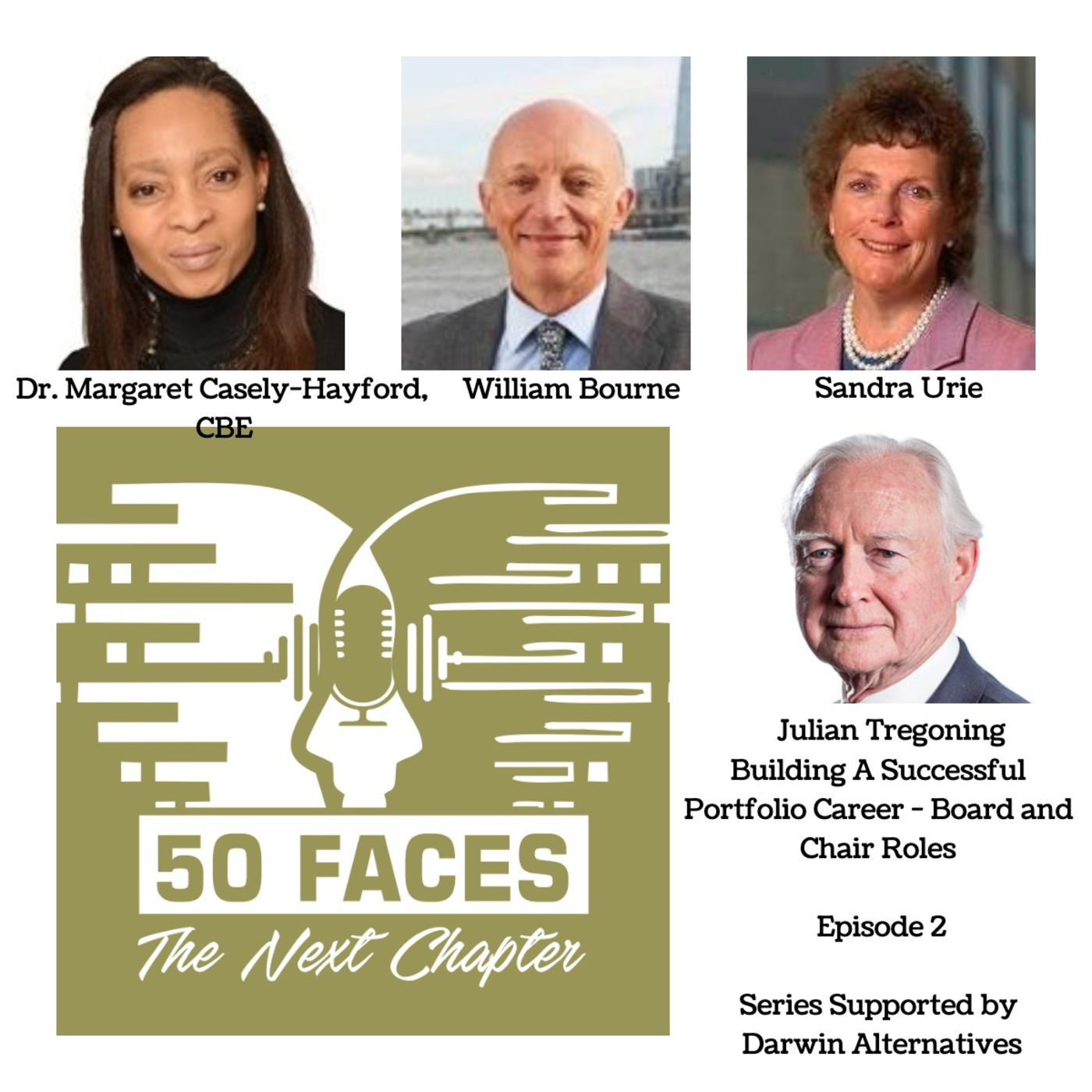
Dr. Margaret Casely Hayford discusses the importance of expressing the values of an organization through a chair role: 3.15 to 5.55
Sally Bridgeland believes in leveraging technology and ensuring that all issues are on the table: 4.51 to 7.02
William Bourne shares his insights on being an effective chair: 11.03 to 12.03
Jan Nicholson discusses how she added value to roles even outside her area of expertise: 2.23 to 5.29
Sandy Urie brings her extensive experienced to investment committees: 13.37 to 15.52
Caroline Burton explains the differences between being a director and an executive here, as well as what happens when a non-executive role ends: 17.56 to 20.13
Dennis Archer on the importance of better diversity on Boards and at the Executive Level: 7.24 to 8.58
Sharmila Kassam aims to make a difference to each of her Boards by reminding them of the benefits of diversity: 13.32 to 16.45
Go to our Meditations Hub for a series of free inspiring meditations. Whether you want to start the day with a positive mindset, reset during the day, calm your mind or draw upon the power to forgive, these reflections will encourage you to give yourself this time.
Go to our Coaching Hub for videos from some of our inspiring guests and coaches to help with your career and personal development.
Hear from Oli Shakir-Khalil about his mental health advocacy here: Listen from 6.30 to 12.5 on Apple or Spotify.
COMING SOON
If you would like to recommend a guest, send us any resources to share with our listeners, make any suggestions, or contribute to the discussion, please write to us via the form below: